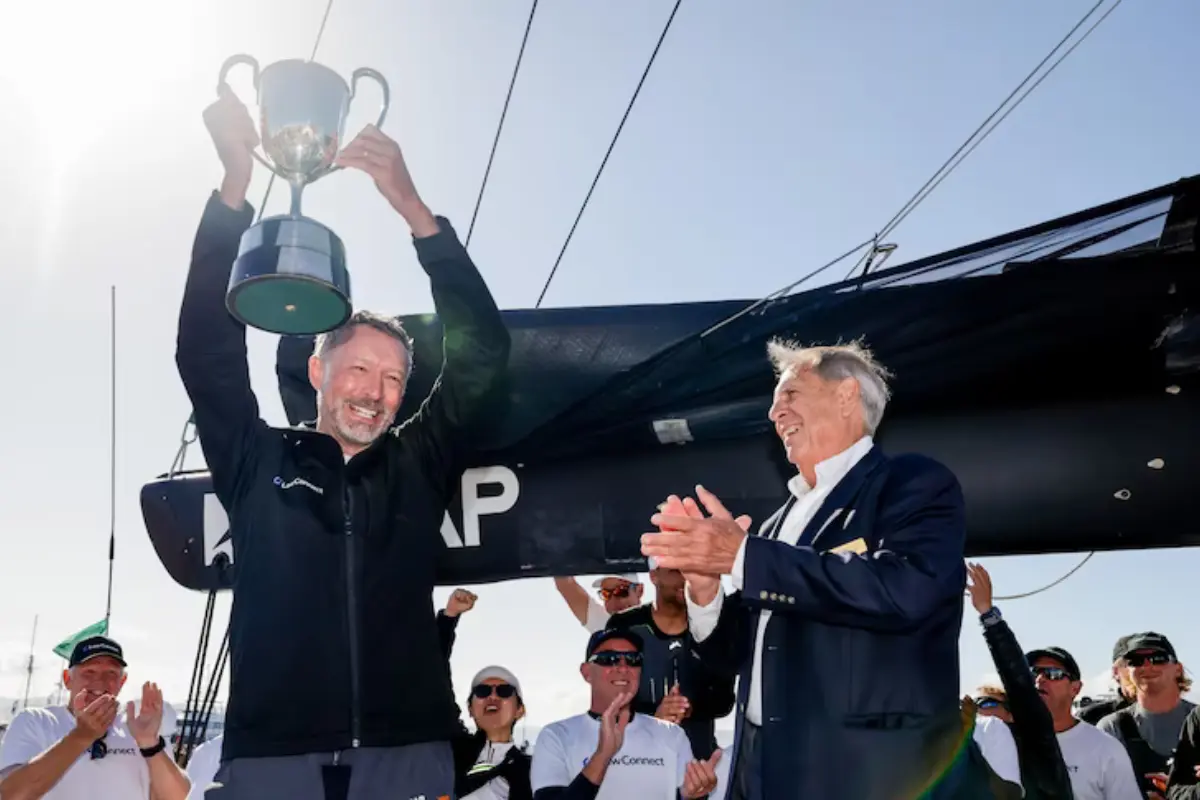

Christian Beck stands out for his calm, trust-based leadership across elite sailing, academic research, and creative pursuits. From winning Sydney to Hobart line honours to leading complex systems research at a top university, he shows how balance, expertise, and purpose drive lasting success.
A Leadership Style Built on Trust, Not Control
Christian Beck stands out because he leads without noise. In the world of elite sailing, many skippers rely on constant instructions, loud commands, and visible authority. He chooses a different path. As owner, figurehead, and skipper of LawConnect, he believes that trusting professional sailors produces better results than trying to control every detail.
This belief proved its value in the Sydney to Hobart race, one of the toughest offshore competitions in the world. His 100ft supermaxi achieved line honours in 2023, crossing the finish line just 51 seconds ahead after a dramatic finish. The race began on Boxing Day from Sydney Harbour, where pressure and attention peak. Instead of reacting emotionally, he stayed calm and allowed the crew to execute their plan.
He openly describes himself as a “sailing bullshitter”, a phrase that hides deep self-awareness. He understands that leadership does not always mean action. Sometimes, leadership means knowing when to step aside so expertise can shine.
The “Do Nothing” Strategy That Actually Works
His approach often gets labeled as a “do nothing” strategy, but that description misses the truth. Doing nothing during the race requires intense preparation beforehand. He focuses on funding, overseeing alterations, approving new sails, and building the right environment for success.
During competition, he hands tactics to a crew of 15, led by Tony Mutter, a highly respected New Zealander with deep experience. Mutter previously served as sailing master when the yacht, then known as Perpetual LOYAL, set a race record in 2016. That history matters. It shows continuity, learning, and respect for proven skill.
Rivals like Comanche, now led by co-skippers James Mayo and Matt Allen, continue to raise the bar. Heavy downwind conditions often favor faster competitors, while varying conditions reward balance and adaptability. LawConnect improved performance with sails that are 10 to 20 per cent lighter, boosting speed without sacrificing control. These decisions reflect quiet intelligence rather than flashy risk.
Family Life as a Source of Competitive Strength
Away from racing headlines, his daily life looks ordinary. He shares time with his wife, manages a newborn, and handles nappies and midnight feeds. Instead of seeing family responsibility as a distraction, he treats it as mental training. Parenting builds patience, awareness, and emotional control—qualities that matter in long offshore races.
This grounded routine helped him approach high-stakes sailing without anxiety. He learned that when personal life stays balanced, professional decisions become clearer. Many leaders burn out chasing constant intensity. He chooses steadiness instead, and results continue to follow.
Early Lessons from Film and Storytelling
Long before racing yachts or leading research centers, creativity shaped his worldview. Film entered his life during middle school, when he began documenting his sister’s cancer journey. The goal was not publicity. He wanted people to understand her strength, her hardships, and her humanity without forcing her to explain it repeatedly.
When the film appeared at a school assembly, other students battling cancer asked for similar support. That moment changed his understanding of storytelling. He saw how visual media could create empathy, reduce isolation, and make pain easier to share. It taught him that purpose matters more than recognition.
This experience built a foundation for everything that followed. Whether in science, sport, or art, he consistently focuses on meaningful impact rather than surface success.
Music, Expression, and a Wider Audience
Alongside film, music remained a constant presence. He grew up playing instruments, writing, and performing. His parents encouraged creativity, not as a hobby, but as a way to connect with others. That support paid off when he earned an American Idol audition.
During the pandemic, he shared more music through social media, reaching people at a time when live performance disappeared. That visibility caught the attention of an American Idol producer, leading to travel to Los Angeles, a golden ticket, and performances in Hollywood.
The experience opened doors to the music industry, but it also clarified limits. Large audiences bring reach, yet they often lack personal impact. He realized that while music connects emotionally, it could not satisfy his deeper desire to help people directly.
Medicine as a Long-Term Calling
At the core of his identity sits medicine. Inspired by his mother and the doctors who helped bring his sister into remission, he developed a strong desire to heal through action. He respects creativity, but he values practical compassion more.
This motivation shaped how he evaluates every opportunity. He measures success not by applause, but by service. That philosophy flows naturally into his scientific career, where real-world outcomes matter more than abstract prestige.
A Scientific Career Focused on Real Systems
As Prof. Christian Beck, he serves as Professor of Applied Mathematics at the School of Mathematical Sciences, Queen Mary University of London, based on Mile End Road, London E1 4NS. He leads the Centre for Complex Systems, a role that demands both intellectual depth and organizational clarity.
His work explores complex systems, nonlinear dynamics, stochastic processes, and statistical physics. Rather than staying theoretical, he applies mathematics to real-world systems such as power grids, sustainable energy, air pollution, and water quality. These areas affect daily life, policy decisions, and environmental outcomes.
From 2017 to 2022, he chaired the Statistical and Nonlinear Physics Division of the European Physical Society (EPS). In 2023, the society elected him to its Executive Committee, reflecting trust at the highest level. He also served as an Alan Turing Fellow at The Alan Turing Institute from 2021 to 2023, where data science meets public value.
Research That Bridges Theory and Impact
His publication record reflects both scale and relevance. With more than 160 papers and nearly 10,000 citations, his research spans diverse fields. Notable work includes residential electricity consumption published in Nature Communications (2022), studies on air pollution statistics in Scientific Reports (2022), and machine learning methods applied to rivers and water quality.
He also explores fundamental questions such as axionic dark matter and dark energy, publishing in Physical Review Letters. These studies show his ability to balance curiosity-driven science with applied research that informs policy and infrastructure.
Major Grants and Collaborative Projects
Funding bodies repeatedly support his work because it connects theory to practice. A major EPSRC grant worth 497K addressed Nash equilibria, load balancing, and networked power systems, working closely with industry partners. This project improved understanding of electricity networks under modern demand.
He also served as co-investigator on Flood MEMORY, a multi-university initiative analyzing flood risk and clustered extreme events. Additional support came from QMUL and Research England, including a 50K Policy Impact grant focused on air pollution statistics and water quality monitoring.
International collaboration remains central. Joint research with Huazhong University of Science and Technology in Wuhan expanded cross-border knowledge exchange, while smaller grants supported impact generation beyond academia.
Teaching with Practical Focus
Teaching remains a priority. He teaches MTH6154 Financial Mathematics 1 during the 2023/24 academic year, guiding QMUL students through structured reasoning and applied problem-solving. He keeps learning accessible through QMPLUS resources and encourages engagement via email appointment office hours.
Rather than overwhelming students, he emphasizes clarity, patience, and relevance. His approach mirrors his leadership style—supportive, calm, and outcome-focused.
Editorial Leadership and Academic Standards
Beyond teaching, he shapes the direction of scientific publishing. He serves on the Editorial Board of Scientific Reports and Entropy, and works as Advisory Editor for Physica A: Statistical Mechanics and Its Applications. As former EPS chair, he often recommends high-quality submissions to EPL, reinforcing rigorous standards.
These roles require judgment, fairness, and a broad view of scientific quality—skills refined through years of interdisciplinary work.
Mentorship and Research Community Building
His influence extends through mentorship. He supervised postdocs such as Evangelos Mitsokapas, Pau Rabassa, Randall Martyr, and Benjamin Schaefer, supporting work on airplane delays, superstatistical methods, electricity markets, and power grid dynamics. Many moved on to strong academic and industry roles.
He also guided PhD students including Shihan Miah (quantum turbulence), Dan Xu (share price statistics), Griffin Williams (air pollution statistics), Jin Yan (coupled axion models), and Hankun He (water quality). Each project reflects his commitment to applied relevance and analytical rigor.
Personal Balance Beyond Work
Outside research and sailing, he remains connected to music as a member of the Brentwood Philharmonic Orchestra. Playing in an orchestra reinforces teamwork, discipline, and listening—skills that echo across every area of his life.
For professional contact, colleagues reach him via c.beck@qmul.ac.uk or +44 20 7882 3286, but his real influence shows through systems improved, students trained, and teams empowered.
A Consistent Philosophy Across Domains
Whether leading a yacht, publishing research, or mentoring students, Christian Beck follows the same principle: trust expertise, prepare deeply, and act with purpose. He avoids noise, values clarity, and believes impact matters more than image.
That consistency explains his success across sailing, science, and creative expression. He proves that calm leadership, grounded values, and thoughtful decision-making can connect worlds that seem unrelated on the surface.



Leave a Reply