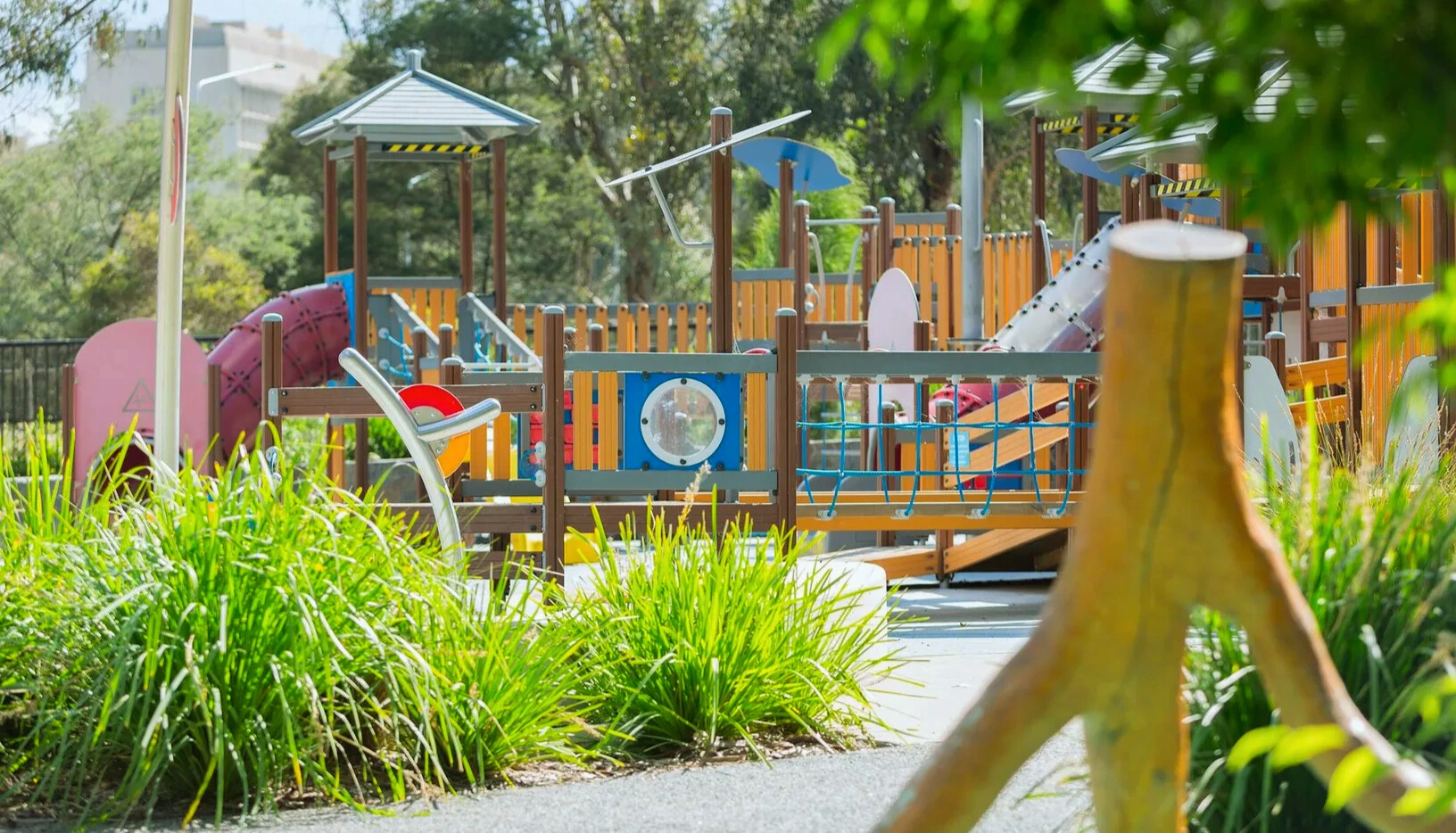

From a child’s idea in Indiana to world-class inclusive parks across continents, the Boundless movement has changed the way we think about play — one ramp, one swing, and one community at a time.
A Vision of Play Without Barriers
The story of Boundless Playgrounds began in the United States in the late 1990s, born from the simple but profound belief that every child — regardless of ability — deserves to play side by side. What started as a modest non-profit concept soon grew into a design philosophy shaping more than two hundred playgrounds across thirty-one U.S. states and Canada, inspiring countless international projects, including Australia’s own Boundless Canberra.
These playgrounds are more than recreational spaces. They are social equalisers. Each is designed with ramps, sensory panels, musical elements and soft surfaces to ensure children with mobility, vision or sensory differences can play safely and freely. What makes them remarkable, however, is not just the design — it’s the communities that build them.
Fort Wayne, Indiana – Taylor’s Dream (2011)
In 2011, a young girl named Taylor Reuille dreamed of a place where her best friend Mallory, who had spina bifida, could play without limitations. Her idea led to Taylor’s Dream Boundless Playground, the first of its kind in Indiana and a national model for inclusion.
The playground is cleverly divided into three pods — Alpha, Beta and Gamma — representing different play experiences: physical challenge, imagination and sensory exploration. The Alpha pod houses the Aero Glider, a wheelchair-accessible ride-on platform. The Beta pod features interactive equipment like the NEOS 360, which encourages movement through light-and-sound challenges. Gamma is quieter — a sensory garden with fossil-themed sculptures and tactile surfaces where children can rest and explore.
Funding came from an impressive grassroots effort. The project won forty thousand dollars through the Pepsi Refresh Challenge and another thirty thousand from CVS’s All Kids Can program, which supports children with disabilities. In total, nearly one million dollars was raised through local donations, business sponsorships and family fundraisers. Volunteers later joined an Adopt-a-Playground program to maintain it year-round.
Taylor’s dream became a statewide inspiration. Within a decade, dozens of inclusive playgrounds across the Midwest would credit Fort Wayne’s project for showing what true accessibility could look like.
Boundless Canberra – Australia’s First All-Abilities Playground (2013)
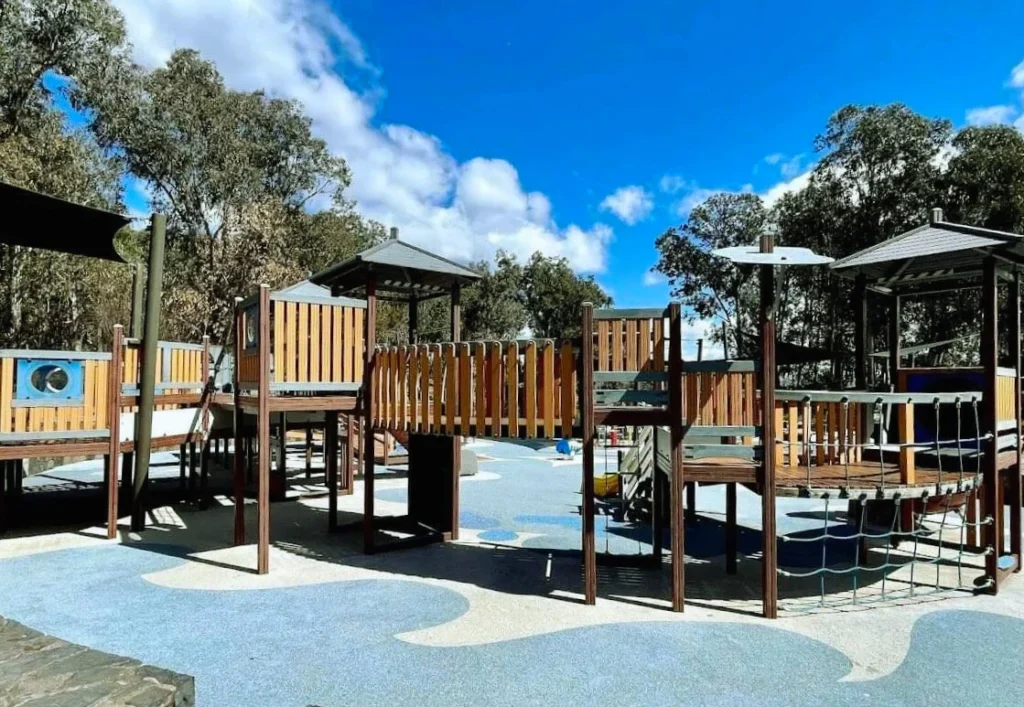
When Boundless Canberra opened on the banks of Lake Burley Griffin in October 2013, it symbolised more than the capital’s centenary. It was a statement that play belongs to everyone. Built at Kings Park, off Wendouree Drive in Parkes, it became the nation’s first truly all-abilities playground.
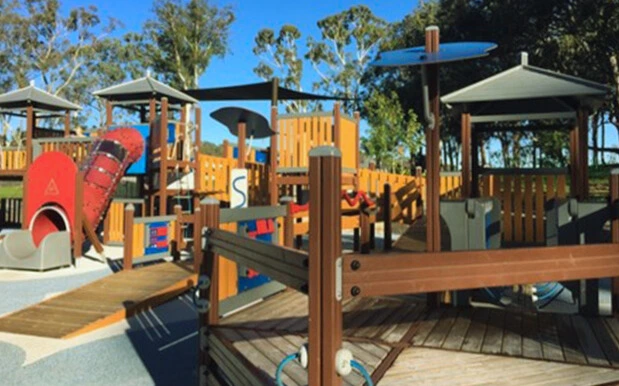
The concept came from a group of public servants who wanted to gift something meaningful to Canberra on its hundredth birthday. The result was a vibrant, multi-level play space designed for children of all ages and abilities, featuring wheelchair-friendly ramps, low-level swings, climbing forts, tactile panels and sandpits with mechanical diggers.
At the opening, Chief Minister Katy Gallagher called it “a place that embodies the spirit of inclusion and equality at the heart of our city.” Project chair Natalie Howson described how ordinary Canberrans helped fund it: “People have put in every week, some of their pay cheque, to make this playground happen. It’s been a true community effort.”
The next phase came in 2018, when the National Capital Authority invited expressions of interest for a semi-transportable kiosk and café. Plans included full utility connections — sewerage, water, electricity — and a deck with outdoor seating within view of the playground. The kiosk was described as the “final milestone” of the Boundless enterprise.
Boundless Canberra continues to evolve. In 2024, a small mobile café, The Griff Coffee Bar, began operating across Wendouree Drive near the National Carillon, ensuring caffeine for parents and energy for kids. The playground has also hosted therapy programs and community events, extending its role from recreation to rehabilitation and inclusion.
Alexander Elementary School, Michigan – Built by a Community (2020–2022)
The COVID-19 pandemic sparked unexpected creativity in Michigan. During lockdowns in 2020, parent Natasha Abbott approached Principal Shanan Henline of Alexander Elementary School in Adrian with an idea: to build a boundless playground so her daughter Dayton, who uses a wheelchair, could play alongside classmates.
The school embraced the challenge. Over two years, the community raised more than one hundred thousand dollars of the one-hundred-thirty-one-thousand goal through lemonade stands, charity drives and donations from the Kiwanis Club of Adrian and Adrian Noon Rotary. The NASCAR Foundation later added fifteen thousand dollars, linking the project to lessons on science, racing and healthy living.
Construction was managed by Miracle Playsystems Michigan, with volunteers completing the build over three days in July 2022. Teachers, parents, students and local contractors assembled ramps, sensory panels and a wheelchair-accessible merry-go-round. Even local businesses donated food and coffee — Morning Fresh Bakeries, Biggby Coffee and Catalyst Church kept workers going.
The playground opened in October 2022 following a one-week curing period for the rubber surface. Henline described it as “a total team effort that turned a dream into something our students can touch.” Families gathered for a picnic preview, and a donor wall recognised anyone who gave over two hundred and fifty dollars. Parent-teacher organisation vice-president Anna Solis-Gautz summed it up: “It’s been amazing watching everyone see this project through. It will serve every child in our community, especially those who couldn’t play before.”
Boundless Backyard – Excelsior Springs, Missouri (2024)
In Missouri, inclusion took on a local twist. The Boundless Backyard Park project in Excelsior Springs aims to transform five acres on Milwaukee Street into a sensory-rich, barrier-free haven. Managed by the Excelsior Springs Parks and Recreation Foundation, the plan includes a butterfly haven, picnic shelter and multi-sensory playground.
Residents can literally leave their mark: engraved bricks are sold for one hundred dollars or two hundred and fifty dollars, with personal inscriptions forming the walkway at Rainbow Splash Park. Participants receive an ivory-coloured certificate featuring their engraving — a lasting keepsake of community pride.
Director Nate Williams emphasised that “every element is being built for every individual, regardless of physical or sensory need.” Parking, restrooms and picnic facilities are funded internally by the Parks Maintenance Division, while the playground itself awaits partial support through a Land and Water Conservation Fund grant.
It is a small-town example of how inclusivity can be achieved without big-city budgets — just imagination, local craftsmanship and a shared belief in accessibility.
Darrell’s Dream – Boundless Playground at Warriors’ Path, Tennessee (2022)
In the Appalachian foothills, Warriors’ Path State Park hosts Tennessee’s only Boundless Playground, known as Darrell’s Dream. In 2022, park officials received a seven-thousand-dollar grant from Enbridge, secured through the Friends of Warriors’ Path group, to support maintenance and new installations.
Park Manager Sarah Leedy said, “We are so appreciative of Enbridge’s support and the Friends group who made this possible.” The funds went toward resurfacing, replacing adaptive swings and expanding wheelchair pathways. Darrell’s Dream remains a model for accessible play in natural settings — blending forest trails, sensory gardens and play zones for children and adults of all abilities.
Leaps & Bounds – Shreveport, Louisiana (2025)
Further south, Shreveport’s Leaps and Bounds Playground reopened in 2025 after major renovations totalling four hundred and seventy thousand dollars, funded by a city bond issue and private partnerships. It is the first project completed under the city’s 2024 parks initiative and the only Boundless-certified playground in Louisiana.
Spearheaded by Right to Play Inc., alongside Mayor Tom Arceneaux and SPAR Director Shelly Ragle, the park now features rubberised surfacing, ramped entries, adaptive swings and musical play panels — all beneath shade sails for the hot Louisiana sun. Founder Dr Karen Gordon, who brought the concept from Connecticut after visiting America’s first Boundless Playground, said, “I wanted a place where every child — regardless of their physical or mental ability — could belong.”
The playground’s relaunch marked the beginning of Shreveport’s inclusive-recreation plan, ensuring every neighbourhood has at least one accessible site within ten minutes’ drive.
Dallas, Texas – A School’s Gift to Its Students (2025)
At Dallas Intermediate School, the concept of play as therapy came to life in 2025 when a new Boundless Playground opened, funded and constructed by the Rotary Club of Dallas. The project began as a small sensory-strip idea but quickly evolved into a full-scale inclusive play space thanks to strong community support.
Rotary co-chairs Barbara Rinker and Arthur Peoples coordinated local sponsorships, while students and teachers helped design equipment that would engage children with autism and mobility challenges. The finished playground includes climbing pods, percussion drums, a xylophone wall, balance tracks and a shaded sensory cocoon for children who need calm spaces.
Principal Tom Traver described the project as “a chance to leave our school better than we found it.” At the ribbon-cutting ceremony, local officials joined volunteers and students in celebration. The playground opened just before the start of the school year, instantly becoming a hub for inclusive outdoor learning.
Metro Atlanta, Georgia – The Boundless Belt of the South (2025)
Atlanta may be famous for its beltline trails, but by 2025 it is also known for its “Boundless Belt” — a network of more than twenty inclusive playgrounds across metro counties, many built with help from the Resurgens Charitable Foundation.
Each site tells its own story of access and joy. Mayor’s Grove Playground at Piedmont Park integrates sensory-rich features that allow children and caregivers of all abilities to play together. Swift-Cantrell Park in Kennesaw boasts 18,500 square feet of accessible fun, from wheelchair gliders to a ropes tower and sensory stations — one of the largest inclusive playgrounds in Georgia. Windy Hill Community Centre in Smyrna features the longest continuous wheelchair ramp in the United States, connecting all levels with soft rubber surfacing. Murphey Candler Park in Brookhaven and HOPE Park in McDonough combine musical zones, high-back swings and wheelchair-accessible merry-go-rounds.
By coordinating municipal efforts and private sponsorships, Atlanta has redefined play equity — ensuring that accessibility is not a feature but a foundation.
Boundless Canberra – The Kiosk Vision (2018–2024)
Returning to Australia, Boundless Canberra reached another milestone when the National Capital Authority sought operators for its semi-transportable café kiosk in 2018. Chief Executive Sally Barnes said at the time, “The playground is a popular destination for locals and visitors. This added amenity will enhance the visitor experience and create an exciting business opportunity.”
The design included essential utilities and a deck with picnic seating under supervision distance of the playground — blending functionality with family comfort. Construction work added water, electricity and sewerage connections, ensuring the site could sustain food service and shaded rest zones.
Today, the area thrives. The Griff Coffee Bar, parked across Wendouree Drive, has become a favourite for parents seeking respite while their children explore. Together, the playground and kiosk demonstrate how inclusive play spaces can also nurture community gathering — playtime for children, pause time for adults.
Beyond the Equipment – The Philosophy of Inclusion
Across continents, Boundless Playgrounds have proven that inclusion requires both design thinking and community empathy. Every ramp, swing or sensory wall carries an underlying principle: to make difference invisible by making accessibility universal.
Early collaborations with Playworld Systems introduced modular designs adaptable to schools, parks and coastal sites. The NEOS interactive technology pioneered at Fort Wayne later influenced digital-sound play systems in modern parks, bridging physical and cognitive development. Today, Boundless principles are embedded into universal-design standards for public spaces worldwide.
Environmental sustainability also shapes new projects. Rubberised flooring now uses recycled materials; energy-efficient lighting and water-conscious landscaping are standard. More importantly, local involvement — from engraved bricks in Missouri to lemonade stands in Michigan — ensures these playgrounds are built not just for the community but by it.
The Ripple Effect of Boundless Play
Each location — from Indiana to Canberra — echoes the same story: the power of ordinary people achieving extraordinary accessibility.
In Fort Wayne, a 12-year-old’s idea reshaped playground policy.
In Canberra, a centenary gift became a landmark of national pride.
In Adrian, parents and children raised funds hand-to-hand.
In Missouri, engraved bricks literally built a path toward inclusion.
In Dallas and Shreveport, civic clubs and city departments proved that accessibility can unite volunteers, corporations and councils alike.
In Atlanta, an entire metro network now ensures no child plays alone.
The global Boundless network is more than infrastructure — it’s an evolving philosophy where empathy meets engineering. Every city that embraces the model learns that accessible design benefits everyone: parents with prams, older visitors and children of every ability and temperament.
Toward 2025 & Beyond
As 2025 unfolds, the Boundless story continues to grow. Governments, charities and local councils are now adapting its blueprint for future developments — not as an optional feature but as a minimum standard for equity in urban planning.
The National Capital Authority’s plans for Boundless Canberra 2.0 include energy-neutral facilities, shade gardens and art installations created by children with disabilities. In the United States, community-driven builds remain strong, supported by hybrid public-private funding models.
What began as a dream has become an enduring framework — proof that the best spaces are those that welcome everyone.
The Freedom to Play
From the sandy banks of Lake Burley Griffin to the green fields of Georgia, Boundless Playgrounds stand as living monuments to imagination and inclusion. They remind us that when play is designed without barriers, it becomes a universal language — one spoken fluently by laughter, teamwork and joy.
In the words of Fort Wayne’s Taylor Reuille, whose idea sparked a movement:
“Now my friend Mallory can play with all the other kids.”
It’s a simple sentence that still defines the mission three decades later. Boundless playgrounds are not just built spaces — they are promises kept.


Leave a Reply