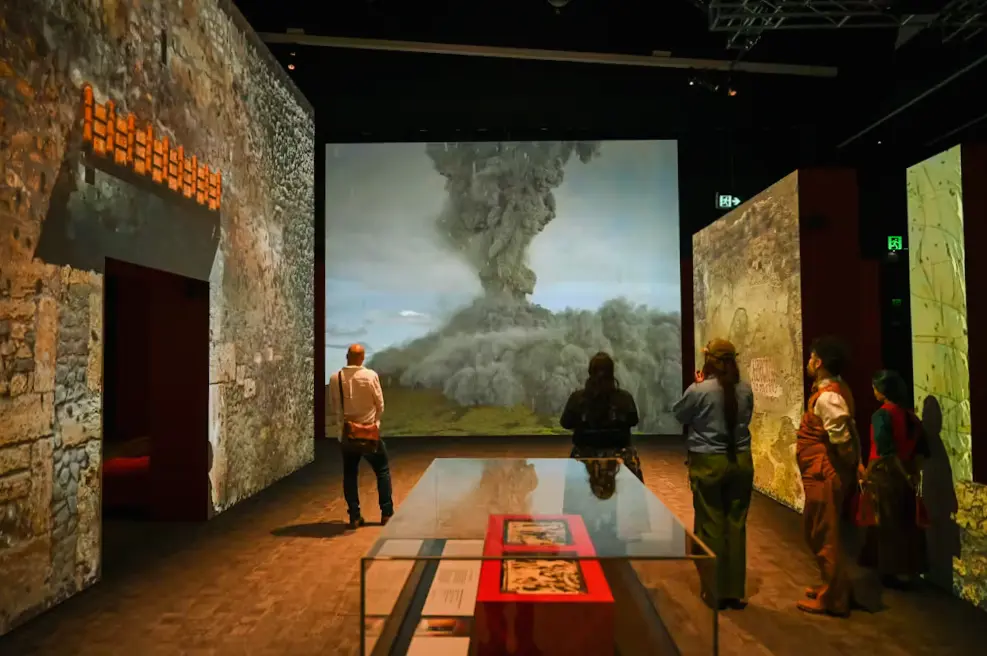

The Pompeii exhibition Canberra turned the National Museum of Australia into a time machine. For a few months, visitors could step out of modern Canberra and straight into the streets of an ancient Roman city frozen at the moment disaster struck.
Through enormous digital projections, soundscapes and more than 90 original objects from Pompeii, the exhibition invited people to walk a Roman street, stand beneath a looming digital Mount Vesuvius and see the everyday belongings of a community wiped out almost 2,000 years ago. It was part blockbuster show, part history lesson and part emotional encounter with a city that still feels strangely alive.
In this long-form guide, we’ll explore every angle of pompeii exhibition canberra – from its immersive technology and carefully chosen artefacts, to its human stories, visitor reactions and long-term impact on how Australians see ancient history.
What Was the Pompeii Exhibition Canberra?
The Pompeii exhibition Canberra was a major international exhibition hosted at the National Museum of Australia in Acton. It ran from December 2024 through to early May 2025 and was billed as a multi-sensory, immersive experience rather than a traditional display of glass cases and text panels.
At its core, the exhibition combined:
- A 360-degree digital recreation of the eruption of Mount Vesuvius
- A long, projected street from the city of Pompeii, shown “then and now”
- A selection of more than 90 artefacts from the archaeological park of Pompeii
- Powerful stories about the people who lived and died there
The museum described the exhibition as a “multi-sensory immersive experience” that recreated life in Pompeii on the eve of the eruption and followed the city through destruction, rediscovery and ongoing archaeological work. Rather than focusing only on ruins and tragedy, pompeii exhibition canberra set out to show the city as a place of daily routines, social life and human relationships.
Pompeii Exhibition Canberra – A Global Collaboration
One reason the Pompeii exhibition Canberra felt so ambitious is that it was built on a major international partnership. The show was an exclusive collaboration between:
- The National Museum of Australia in Canberra
- Parco Archeologico di Pompei in Italy (the managing authority for the site)
- Réunion des Musées Nationaux – Grand Palais in France
- GEDEON Experiences, a French media and production company specialising in immersive shows
The immersive component, sometimes called Pompeii Immersive, was originally developed in Europe and adapted for its Australian premiere. GEDEON’s team used high-resolution projections, 3D reconstructions and custom sound to create a virtual Pompeian street and a digital Mount Vesuvius that erupted on a loop.
National Museum director Katherine McMahon called the show “a portal through time, unveiling the secrets of an ancient world”, saying it allowed people to experience Pompeii both as a Roman city and as an ongoing site of discovery “like never before”. That sense of stepping directly into another time was exactly what the collaboration was designed to achieve.
Pompeii Exhibition Canberra – Immersive Streets & Erupting Volcano
If you ask visitors what they remember most vividly about the pompeii exhibition canberra, two features come up again and again: the recreated street and the erupting volcano.
Walking a Roman street in Canberra
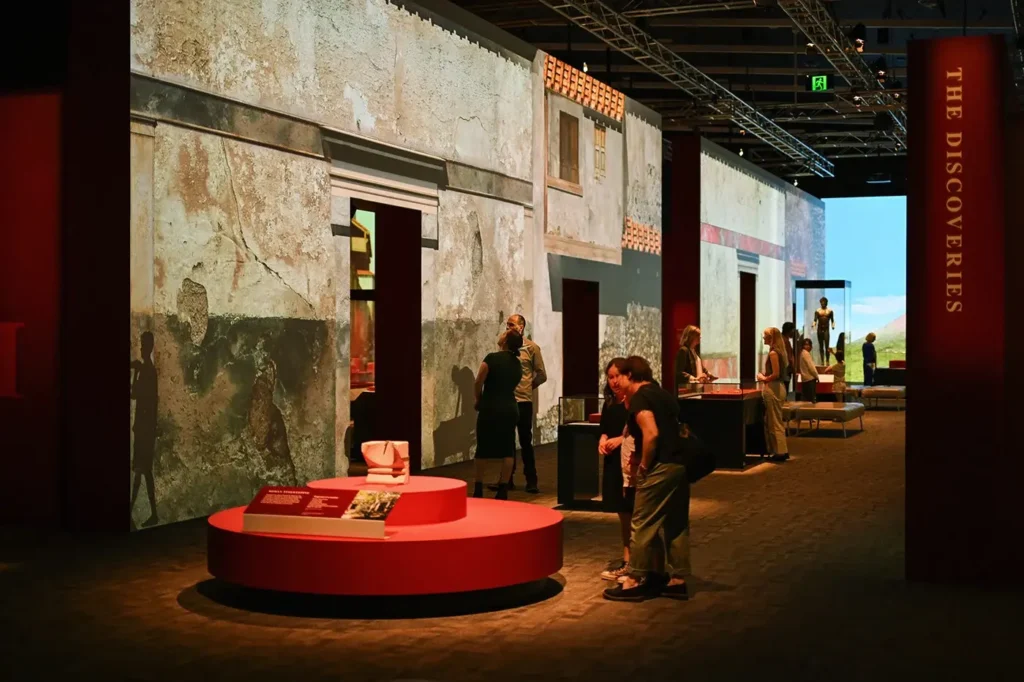
One of the galleries was transformed into a 35-metre Pompeian street. Along its length, visitors saw projected building façades, doorways, balconies and windows taken directly from real locations in Pompeii. Shadowy figures appeared and disappeared: shoppers, workers, children, people visiting shrines or stopping to talk.
The street had a “then and now” feel. On one side, visitors saw reconstructions of houses and shopfronts as they might have looked in 79 CE: painted walls, signage, open doorways and bustling movement. On the other, they saw modern footage of the same buildings as they stand today in the archaeological park – weathered stone, missing roofs and exposed interiors.
Created by Gedeon Programmes, the streetscape surrounded visitors with light, sound and subtle movement so they felt as though they were standing inside the city itself. Everyday sounds – footsteps on stone, quiet chatter, the rumble of carts – gave the impression that life was continuing beyond the edges of the screen.
A 360-degree eruption of Mount Vesuvius
The emotional heart of the pompeii exhibition canberra was its digital volcano. In a circular space with tall projection walls, visitors stood inside a 360-degree recreation of Mount Vesuvius and the surrounding landscape. Every 15 minutes, day turned to night as the volcano erupted in light, colour and sound.
The sequence showed ash plumes rising, fiery fragments raining down and thick clouds engulfing the city. Audio effects layered thunder, crackling, distant shouts and the low roar of pyroclastic flows. As the eruption progressed, the sky darkened and the city disappeared under a storm of ash.
One critic described this feature of the exhibition as a “volcanic explosion every 15 minutes” that turned scientific reconstructions into something visitors could feel in their bodies. For many, it was the moment when Pompeii stopped being an abstract story and became a real place facing a terrifying natural disaster.
Pompeii Exhibition Canberra – Artefacts from Everyday Life
While the technology was spectacular, the pompeii exhibition canberra never forgot that physical objects are at the core of archaeology. The show brought together more than 90 artefacts loaned from the archaeological park in Italy, many rarely seen outside Europe.
Highlights from the collection
The artefacts in pompeii exhibition canberra were carefully chosen to represent both the splendour and the ordinariness of Pompeian life. Visitors could see:
- Large frescoes spanning several metres, taken from the walls of grand houses
- Intricate mosaics that once decorated floors and pool surrounds
- Jewellery in gold, silver and bronze, from delicate chains to chunky bracelets
- Sculptures & statues, including religious figures and decorative pieces
- Pottery, glassware & cookware used in kitchens and dining rooms
- Tools and household items from workshops, shops and back rooms
One reviewer commented that the objects ranged from “incredibly delicate marble and stone carvings” to everyday cooking pots and glass vessels, highlighting the full spectrum of life in the city rather than only elite luxury.
The display was arranged to draw attention to the details. Close-up lighting allowed visitors to see brushstrokes in paintings, tool marks in stone and tiny chips in glass. Captions explained how each object was used and, where known, where it came from within the city.
Stories of class & labour
Curators for pompeii exhibition canberra made a conscious effort to include the experiences of people from various social backgrounds. Instead of focusing solely on wealthy villa owners, the exhibition showed:
- the tools and belongings of tradespeople
- storage jars and simple plates used by ordinary households
- religious objects used in small domestic shrines
- items related to enslaved labour and service work
National Museum curator Lily Withycombe said that “at the heart of this exhibition is real, lived human experience, and that’s how people connect with the ancient past.” That meant paying attention not just to statues of gods and grand dining rooms, but also to the aprons, ladles and storage vessels that kept everyday life running.
Pompeii Exhibition Canberra – Casts, Loss & Human Stories
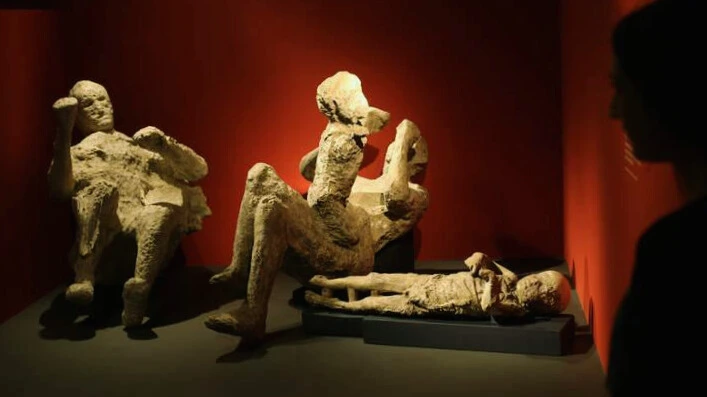
One of the most confronting elements of pompeii exhibition canberra involved the people of Pompeii themselves. Over the 19th and 20th centuries, archaeologists created plaster casts of victims by pouring liquid plaster into voids left in the ash after the bodies had decomposed. These casts capture final poses in heartbreaking detail.
The exhibition included replica casts of several individuals: adults, a child and even a dog caught in the eruption. Displayed in subdued lighting with sensitive interpretation, they reminded visitors that the disaster was not only a geological event but a human tragedy.
Researchers and curators have increasingly emphasised the need to treat these remains respectfully. Instead of presenting them as morbid curiosities, pompeii exhibition canberra used them as starting points for stories about families, workers and neighbours whose lives were cut short.
One reflection from the curatorial team captured this approach: “While the eruption destroyed the city, it also preserved it.” That preservation allows modern viewers to see what people owned, how they decorated their homes and where they tried to escape – but it also demands empathy and ethical care.
Pompeii Exhibition Canberra – Before, During & After the Eruption
A key strength of the pompeii exhibition canberra was its narrative structure. Rather than treating Pompeii as a single frozen moment, the show unfolded in three stages: life before the eruption, the disaster itself and the long history of excavation and interpretation.
Life in a busy Roman town
The first part of the exhibition introduced Pompeii as a living city. Visitors learned that it was a busy port and regional centre with:
- around 10,000–20,000 residents
- bustling markets and street food stalls
- bathhouses, temples and public buildings
- townhouses, shops and workshops
Digital reconstructions showed painted walls in dining rooms, tiled courtyards filled with plants and rooftop terraces open to the sky. Artefacts from kitchens, shrines and shops illustrated what people ate, what they believed and how they earned a living.
This focus on daily life helped pompeii exhibition canberra avoid a pure disaster narrative. It reminded visitors that, before it became a symbol of destruction, Pompeii was simply home to thousands of people going about ordinary routines.
The day the sky fell – Mount Vesuvius erupts
The second stage of the exhibition brought visitors to the day of the eruption in 79 CE. While the exact timeline is still debated, most reconstructions suggest a multi-stage event in which:
- ash and pumice rained down over many hours
- roofs collapsed under the weight of debris
- toxic gas and pyroclastic flows swept through the city
In the 360-degree eruption space, the pompeii exhibition canberra used scientific models, historical accounts and creative sound design to show how quickly conditions turned deadly. Audio narration and projected maps helped explain why some residents escaped while others were trapped.
For modern audiences used to seeing the ruins in bright Italian sunlight, this dark, chaotic environment was confronting. The digital eruption made clear that Pompeii was not simply buried; it was first shaken, suffocated and burned.
Rediscovery & archaeology
The final part of pompeii exhibition canberra looked at what happened after the city disappeared beneath ash. Centuries later, Pompeii was rediscovered and became one of the world’s most famous archaeological sites.
Panels and videos explained how early excavations in the 18th and 19th centuries were often driven by treasure hunting and royal collections. Over time, techniques became more rigorous, shifting towards documentation, conservation and scientific analysis.
Recent footage from active digs showed archaeologists using drones, 3D scanning and digital mapping. Newly excavated objects, such as a bronze jug from the House of Leda and the Swan, demonstrated that Pompeii still has many stories to tell.
Curator Lily Withycombe observed that “the story of Pompeii is so important because archaeology was born here.” By placing the exhibition within that broader history, pompeii exhibition canberra emphasised that understanding the past is an evolving process, not a finished picture.
Pompeii Exhibition Canberra – Visitor Reactions & Reviews
The pompeii exhibition canberra quickly established itself as one of the National Museum’s major draws. Described as a summer blockbuster, it attracted visitors from Canberra, interstate and overseas.
Critical response
Arts writers and reviewers generally praised the exhibition. Common themes in reviews included:
- Admiration for the scale and ambition of the immersive elements
- Appreciation of the focus on everyday life and lesser-known stories
- Emotional impact of the human remains and personal objects
Several commentators highlighted the balance between spectacle and substance. One noted that the eruption and streetscape sequences enhanced rather than overshadowed the artefacts, helping visitors imagine the objects in their original settings rather than seeing them as isolated museum pieces.
Another reviewer pointed out that pompeii exhibition canberra encouraged visitors to think about modern risks and disasters, drawing a subtle parallel between ancient volcanic danger and contemporary concerns about climate, environment and urban vulnerability.
Public impressions
Visitor comments shared online and in word-of-mouth conversations suggest a mix of excitement and reflection. Many people:
- described the eruption sequence as intense but unforgettable
- praised the variety and beauty of the artefacts
- commented on the emotional impact of seeing casts of victims
Some visitors noted that there was a lot to take in and that slower pacing rewarded repeat visits. Others commented on the ticket price, pointing out that blockbuster exhibitions with high-end technology are costly to produce but also hard to experience anywhere else.
Pompeii Exhibition Canberra – Why It Mattered for Canberra
Beyond its immediate wow factor, the pompeii exhibition canberra had broader significance for the ACT and for Australian museums more generally.
A Southern Hemisphere first
The Canberra show was the first time this particular immersive Pompeii experience had been presented in the Southern Hemisphere. That gave the National Museum a genuine exclusive and positioned the city as a serious destination for big-ticket cultural events.
For locals, it meant they could see world-class content without travelling to Europe. For interstate travellers, the exhibition added another reason to plan a trip to Canberra, alongside the National Gallery, Parliament House, the Australian War Memorial and other national institutions.
A showcase for museum technology
The pompeii exhibition canberra also became part of a larger conversation about technology in museums. Australian institutions have increasingly turned to projection, VR, AR and digital storytelling to attract audiences who are used to high production values in their everyday media.
One museum expert noted that “the capacity for immersive technology to allow us to see and experience what has been lost to the ancient past should not be underestimated.” At the same time, there is an ongoing debate about cost, accessibility and the risk that screens might distract from original objects.
By most accounts, pompeii exhibition canberra managed to strike a healthy balance. The technology didn’t replace artefacts; it framed them and gave visitors emotional entry points into their stories.
Education & school programs
The National Museum supported the exhibition with school programs, audio material and teacher resources. Students could explore themes such as:
- natural disasters and risk
- life in ancient Rome
- archaeology and conservation
- ethics of displaying human remains
For schools, pompeii exhibition canberra offered an engaging way to meet curriculum goals in history, geography and social studies while giving students a memorable, sensory experience they couldn’t get from a textbook alone.
Pompeii Exhibition Canberra – A City That Still Speaks
In the end, the lasting achievement of the pompeii exhibition canberra was its ability to make a distant catastrophe feel personal and immediate. Visitors didn’t just read about Mount Vesuvius; they heard it rumble around them. They didn’t just see static ruins; they walked through a living street and watched it vanish under ash.
Most importantly, they saw the jewellery, cookware, statues and tools that belonged to real people – parents, children, workers, business owners, enslaved individuals – whose lives were interrupted on an ordinary day in 79 CE.
As the museum’s director put it, the exhibition “connects us with the people and their lives in entirely new ways.” That connection lives on long after the digital volcano has gone dark and the crates have been packed for their journey home.
For anyone still searching pompeii exhibition canberra, this article stands as a record of what the exhibition achieved and why it resonated so strongly. It reminds us that even cities buried in ash can continue to speak – not only about the past, but also about how we live, what we value and how we face disaster in our own time.
FOR MORE INFORMATION VISIT US AT AUSTRALIANMAGAZINE.COM.AU




Leave a Reply