
News
The Petra Shasha Case-From Classroom to Courtroom


Former Canberra student teacher Petra Shasha was found guilty of grooming and sexually abusing a 15-year-old boy she met during a 2020 school placement. The ACT Supreme Court sentenced her in 2025 to a community-based order and fine, citing her failure to verify the boy’s age despite his deception. The case highlights the dangers of digital grooming & blurred teacher-student boundaries in Australia’s education system.
First Meeting at St Edmund’s College (2020)
In late 2020, 24-year-old student teacher Petra Shasha began a short placement at St Edmund’s College in Canberra. During that time, she met a 15-year-old Year 9 boy who was never one of her students but often lingered near her classroom with friends. According to trial testimony, the teenager and his friends sought her attention during lunch breaks, trying to “flirt” with her.
Justice John Burns later remarked:
“I am satisfied it was him who sought you out… There is no evidence you encouraged that behaviour at the time.”
Shasha left St Edmund’s after her practicum & took work at nearby Canberra Girls Grammar School. She told the court that more than 20 students from St Edmund’s sent her social-media friend requests afterwards — she ignored them all except one.
A Chance Meeting & Renewed Contact (Early 2021)
In February 2021, the pair unexpectedly ran into each other at a sporting event. Soon after, the boy contacted her on Instagram, claiming he was 16 and needed help with a Year 10 assignment. She believed him — or at least said she did — and began replying.
Their chats became frequent. Shasha started giving him lifts in her car, sending him money, designer clothes, alcohol and vapes, and sharing sexualised images and videos. One photograph, later shown to jurors, depicted Shasha in a department-store change room wearing only a G-string.
The boy told police that he “used to go to her classroom to say hello” & would “pretty much flirt with her”. He admitted to friends that he lied about his age and even bragged falsely that he had sex with the teacher to impress peers & make his girlfriend jealous.
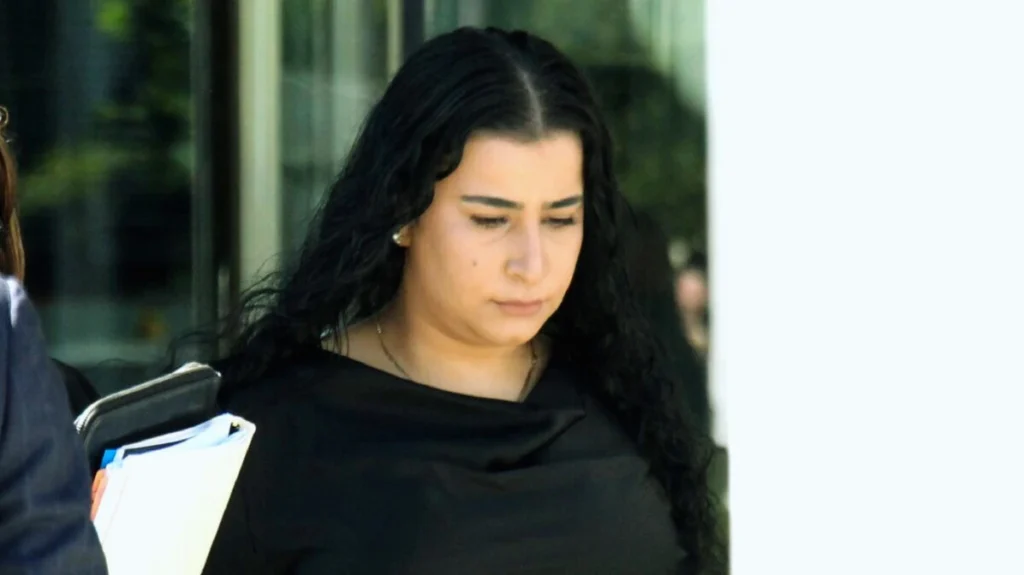
Police Investigation & Initial Charges (2021 – Feb 2022)
In December 2021, ACT Policing received a complaint about an inappropriate relationship between a female student teacher & a boy. Detectives from the Sexual Assault and Child Abuse Team executed a raid at Shasha’s Gowrie home on 20 February 2022, seizing her electronic devices & arresting her.
She was 26 years old. Two initial charges were laid:
- Using a carriage service to transmit indecent material to a person under 16.
- Committing an act of indecency on a 15-year-old.
Prosecutor Sam Bargwanna told the court that further charges were likely.
Bail & Strict Conditions (Feb 2022)
After one night in custody, Magistrate Beth Campbell granted Shasha bail on strict terms. She was forbidden to:
- Contact the boy or five other named individuals, directly or indirectly.
- Approach within 100 metres of St Edmund’s College, Canberra Girls Grammar School, or St Clare’s College.
- Retrieve belongings from Canberra Girls Grammar only under police escort.
Bargwanna warned that Shasha had already contacted the boy before court, prompting Campbell’s sharp caution:
“You can’t send messages, can’t contact through someone else, can’t write, can’t approach.
If you see him in a shopping centre and he approaches you, you get away — because a court order trumps everything.”
Additional Grooming Charge & Not-Guilty Pleas (Mar 2022)
A month later, on 21 March 2022, police filed a new charge of grooming a young person, alleging Shasha “encouraged a boy to commit an act of a sexual nature between 2020 & 2021”.
Represented by Rachel Fisher of Kamy Saeedi Law, she entered not-guilty pleas to all three charges before Magistrate Robert Cook. The matter was listed for a June 2022 pre-hearing mention.
Pre-Trial Developments (2022 – 2023)
Between 2022 & 2023, the case advanced to the ACT Supreme Court. Nearly 20 witnesses — including police officers, school staff, parents & a forensic psychiatrist — were scheduled to testify.
A minor cannabis-supply charge was dropped after a directed acquittal. Suppression orders protected Shasha’s identity & that of St Edmund’s until the verdict.

Trial Before the ACT Supreme Court (Sep – Oct 2024)
In September 2024, now 28, Petra Shasha faced six charges:
- Persistent sexual abuse of a child
- Two counts of grooming
- Two counts of committing an act of indecency
- Supplying pornographic material to a young person
Prosecution Arguments
Crown Prosecutor Emilija Beljic described Shasha’s conduct as a “serious offence occurring with some frequency over a long period.” She said the teacher manipulated the boy through gifts, money & intimacy, adding:
“There were many indications he was younger — his school year, his appearance, his conduct — yet she chose to ignore them.”
Defence Arguments
Defence Barrister Sam Pararajasingham countered that the boy was “assertive & persistent,” saying:
“This was a victim who behaved in a manner beyond his years. He repeatedly told her he was sixteen, sought out contact & demanded sexual photographs.”
He urged the court to consider the teenager’s agency and deceit in telling Shasha his false age.
Expert Testimony
Forensic psychiatrist Dr Richard Furst told the court that Shasha’s actions were not motivated by sexual gratification:
“She did what she did to make him happy. I don’t think she was getting off on it.”
He found her risk of re-offending to be low, though it could rise if she were again around teenage boys — a scenario the judge called “realistically unlikely”.
The Boy’s Account
In police interviews played to jurors, the boy admitted asking for explicit photos and bragging about them to friends. He said Shasha told him, “Don’t show anyone.”
He confessed that lying about his age was meant to “sound cool” & make his girlfriend jealous.
Jury Verdict & Court Reaction (Oct 2024)
After a one-day deliberation, the jury found Petra Shasha guilty on four counts:
- Persistent sexual abuse of a child
- Grooming
- Committing an act of indecency
- Supplying pornographic material to a young person
She was acquitted of two other charges.
Justice Burns stated that her belief the boy was 16 was “honest but inadequate.” The verdict, he said, aligned with her believing the boy’s lie but failing to take reasonable steps to confirm it.
Immediately after conviction, she was freed on bail pending sentencing.

Suppression Orders Lifted (1 October 2024)
On 1 October 2024, the court lifted name and school suppressions, publicly identifying her as Petra Shasha, former student-teacher at St Edmund’s College.
Justice Burns ruled:
“Only people already aware of the matter will be able to identify the victim.”
Media across Australia reported her identity, reigniting debate about teacher-student boundaries and trainee supervision.
Sentencing Submissions (Feb – Mar 2025)
At her sentencing hearing in early 2025, prosecutors sought jail, arguing the offences were serious & sustained.
Beljic pressed:
“It was a very serious offence. It happened over a long period of time with some frequency.”
The defence stressed Shasha’s remorse and the boy’s deception. Pararajasingham told the judge the teen “deliberately set out to deceive” and that Shasha had already suffered “extra-curial punishment” through online vilification.
Psychiatric reports confirmed she had lost her teaching accreditation & would never work with children again.
The Sentence-March 2025
On 14 March 2025, Justice John Burns sentenced Petra Shasha to a one-year & eleven-month Intensive Corrections Order, to be served in the community, fined her $1,000, & ordered mandatory counselling.
He said:
“There is little, if any, prospect of re-offending in the future.
This case falls outside the usual sentencing for such offences.”
He noted the boy’s deceit & emotional immaturity, acknowledging the “mutually complex dynamic” but emphasising adult responsibility:
“You did not take reasonable steps to determine his age.”
He described the matter as “not a typical grooming case.”
The court accepted evidence that she had been subjected to extensive online abuse after her name was made public & considered that as mitigation.
Emotional Aftermath
As the sentence was read, Shasha wept and whispered “thank you” to her solicitors Rachel Fisher and Michael Kukulies-Smith. She embraced her former lawyer after leaving court.
The boy, meanwhile, expressed guilt to his parents when police arrested Shasha, telling them:
“I can’t live without her.”
Justice Burns noted, “He blamed himself — though I do not suggest he should.”
Professional & Legal Consequences
Petra Shasha is now permanently barred from child-related employment across Australia. She has lost her teaching registration & university placement eligibility.
The ACT Education Directorate and St Edmund’s College conducted policy reviews following the trial, reinforcing supervision requirements for student teachers & tightening social-media protocols.
Broader Lessons from the Petra Shasha Case
The Petra Shasha case underscores the modern dangers of teacher-student contact via social media. Even without sexual intercourse, digital grooming — through messages, gifts & imagery — meets the legal threshold for child-sexual offences.
It also re-opens questions about “reasonable belief of age.” Shasha’s defence that she thought the boy was 16 was rejected because she failed to confirm it — a reminder that belief must be reasonable, not merely asserted.
Education & justice officials say the case reveals how trust and power imbalance can be exploited digitally. Teachers are urged to avoid all private messaging with students & to maintain strict professional distance even after leaving placements.
The Final Word
From her 2020 classroom placement to her 2025 sentencing, Petra Shasha’s story traces how blurred boundaries can unravel lives.
The ACT Supreme Court’s decision balanced the boy’s manipulation & deceit against her professional duty to protect him.
“He was an immature teenager,” Justice Burns said. “But you were the adult.”
Shasha’s conviction — though resulting in community service rather than prison — remains a landmark reminder that even non-physical grooming is a crime.
Support Services
If this article raises concerns for you or someone you know, please contact:
- 1800 RESPECT: 1800 737 732 (24-hour sexual assault, family & domestic violence line)
- Lifeline: 13 11 14 (24-hour crisis support)
- Kids Helpline: 1800 551 800
- Canberra Rape Crisis Centre: (02) 6247 2525
FOR MORE RELATED ARTICLES VISIT US AT AUSTRALIANMAGAZINE.COM.AU


Big Sky Publishing is one of the clearest examples of what independent publishing can achieve when guided by purpose rather than scale alone. Based in Newport, New South Wales, this 100% Australian-owned publisher has built a strong identity around local stories, national memory, and books that speak directly to Australian readers. In a market crowded with global imprints and commercial churn, Big Sky has carved out a reputation for authenticity, editorial care, and subject matter that matters.
What makes the company especially interesting is not just what it publishes, but how it publishes. Big Sky combines the reach of traditional publishing with a sharp focus on Australian content, supported by wide distribution through Simon & Schuster Australia. That balance has helped it grow into a respected name across military history, biography, true stories, current affairs, lifestyle, Indigenous perspectives, and children’s publishing.
What Is Big Sky Publishing?
Big Sky Publishing is an independent Australian book publisher established to champion local stories and Australian voices. Its catalogue reflects a clear editorial mission: to preserve, explain, and celebrate the country’s history, culture, and lived experience.
Unlike many publishers that chase trends across every category, Big Sky has built depth in carefully chosen areas. That focus gives the brand consistency and credibility. Readers know what to expect: well-produced books, strong research, and a commitment to authenticity.
The Publishing Identity Behind Big Sky
A publisher’s identity is often defined by three things: the stories it chooses, the standards it keeps, and the audience it serves. Big Sky performs strongly in all three.
1. Local and independent
Being independently owned matters. It allows Big Sky to support Australian authors and projects that larger multinational houses might otherwise overlook. It also means editorial decisions can be made with local relevance in mind, rather than only global commercial appeal.
2. Traditional publishing model
Big Sky operates through the classic publishing process:
- manuscript development
- editing
- design and production
- marketing
- distribution
That is important because it signals a full-service approach. Authors are not just handed a logo and a stock template; they benefit from editorial support and market-facing production standards.
3. Strong distribution reach
Through distribution by Simon & Schuster Australia, Big Sky titles gain access to a much wider retail network than many small publishers can reach on their own. That helps its books appear in bookstores, online retailers, and direct sales channels with far greater visibility.
Core Genres and Publishing Strengths
Big Sky’s list is broad enough to attract different readers, but focused enough to remain coherent. Its strengths sit in areas where research, clarity, and credibility matter.
Military history and Australiana
This is one of Big Sky’s signature areas. The publisher is especially well known for books dealing with Australia’s wartime past, military heritage, and national identity. Its role as the official publisher for the Australian Army History Unit adds weight to this reputation.
These books appeal to:
- history readers
- veterans and defence communities
- families researching service records
- educators and institutions
- anyone interested in Australian identity
A strong military history title does more than recount battles. It places events in context, explains their significance, and preserves the human stories behind the record. Big Sky’s focus on accuracy makes it well suited to this kind of publishing.
Biography and true stories
Readers are drawn to real lives because they reveal larger truths. Big Sky publishes memoirs, personal journeys, and lived experiences that resonate with authenticity. This is a category where the publisher’s editorial restraint matters. Good biography is not about exaggeration; it is about clarity, honesty, and structure.
True crime and current affairs
In true crime and current affairs, trust is everything. Readers expect careful reporting, sound evidence, and a serious tone. Big Sky’s strength here is its reputation for well-researched, reliable content rather than sensationalism.
Health, lifestyle, and self-help
This category broadens the publisher’s audience and adds practical value. Well-made lifestyle books need to be accessible, useful, and clearly written. Big Sky’s experience with straightforward, reader-friendly nonfiction gives it an advantage here.
Indigenous culture
Publishing Indigenous histories and perspectives requires sensitivity, consultation, and editorial discipline. Big Sky’s inclusion of this area shows an awareness that Australian publishing should reflect the full breadth of the nation’s stories, not just its dominant narratives.
Children’s books
Branded as “little books with big messages,” Big Sky’s children’s titles are designed to be both entertaining and meaningful. Picture books, early readers, and educational stories serve an important role: they introduce values, language, and ideas in a format children can absorb easily.
Why Big Sky Publishing Stands Out
There are many publishers in Australia, but Big Sky has a few traits that make it distinctive.
It values authenticity
Readers can usually sense when a book has been treated carelessly. Big Sky has built a reputation for books that feel grounded, researched, and purposeful. That matters enormously in nonfiction, where trust is the product.
It supports Australian stories.
There is real value in a publisher that prioritises local material. Australian stories often need a champion because they may not fit the assumptions of larger international markets. Big Sky fills that role well.
It offers professional production standards.s
Independent does not mean amateur. Big Sky’s books are expected to meet the same editorial and design standards readers would associate with major trade publishers.
It reaches both niche and general readers.
Some publishers are too specialised to grow widely; others are so broad that they lose identity. Big Sky manages a useful middle ground. It can publish specialist military history and still appeal to general readers looking for engaging nonfiction or children’s titles.
Practical Examples of the Big Sky Approach
Consider what this model looks like in practice.
- A military history title may combine archival research, veteran testimony, maps, photographs, and narrative structure to create a book that is both educational and readable.
- A memoir may be edited not simply for grammar, but for pacing, emotional clarity, and narrative arc so the reader stays engaged from beginning to end.
- A children’s book may use simple language, strong visual rhythm, and a memorable message to deliver a story that parents, teachers, and children can all value.
This is where experienced publishing matters. A strong publisher does not merely print a manuscript; it shapes it for the reader.
Common Mistakes Publishers Avoid — and Big Sky Appears to Avoid Them
Many smaller publishers struggle in predictable ways. Big Sky’s reputation suggests it has learned to avoid several common traps.
Publishing too broadly
A scattered list can weaken brand identity. Big Sky’s focused catalogue gives it a clearer voice.
Neglecting editorial rigor
Poorly edited books quickly damage credibility, especially in nonfiction. Big Sky’s emphasis on accuracy helps protect its reputation.
Ignoring audience fit
Not every good manuscript is a good commercial fit. Big Sky’s genre choices suggest a disciplined understanding of its audience.
Treating distribution as an afterthought
A book that cannot be found will not be read. Strong distribution is a significant advantage, and Big Sky benefits from it through Simon & Schuster Australia.
Future Outlook for Big Sky Publishing
The future looks promising for publishers that can combine specialist credibility with broad reader appeal, and Big Sky is well positioned for that environment.
Several trends support its model:
- continued interest in Australian history and identity
- strong demand for authentic nonfiction
- growing appetite for real-life stories and memoir
- steady interest in children’s books with educational value
- increased attention to Indigenous voices and local perspectives
Digital discovery will continue to matter, but physical books still hold strong cultural and commercial value, especially in history, biography, and children’s publishing. A publisher like Big Sky, with a clear identity and dependable distribution, is well placed to benefit from both formats.
Final Thoughts
Big Sky Publishing has succeeded by staying true to a clear editorial purpose. It champions Australian stories, publishes across meaningful nonfiction and children’s categories, and maintains the professional standards readers expect from a serious publisher.
Its strength lies not in trying to be everything to everyone, but in being recognisable, trustworthy, and distinctly Australian. For readers, that means books with substance. For authors, it means a publisher that values quality and local relevance. For the wider publishing industry, Big Sky is a reminder that independent publishing can be both commercially practical and culturally important.

In today’s media landscape, certain individuals find themselves thrust into the spotlight not by choice, but through circumstances that test their character. Leigh Pickford is one such person. An Australian woman whose life has drawn public attention due to deeply personal and legal matters, she has come to represent quiet strength and the human capacity to endure hardship while maintaining dignity.
Having followed public stories involving ordinary people facing extraordinary challenges for over thirty years, I’ve learned that these narratives often reveal more about society’s values than about the individuals themselves. Leigh Pickford’s journey offers powerful insights into resilience, privacy, and the complexities of living life under scrutiny.
Background
Leigh Pickford is based in Australia, where she has navigated life away from the limelight for much of her earlier years. Like many Australians, her story is rooted in everyday realities — family, community, and personal aspirations. However, specific events brought her into the public consciousness, turning private struggles into matters of broader interest.
What stands out in her background is the ordinary foundation from which her story unfolded. This relatability is perhaps why her experiences have resonated with so many. She represents countless individuals who face unexpected trials without the armour of fame or fortune.
Key Events
Leigh Pickford gained media coverage due to a series of personal and legal challenges that tested her resilience in profound ways. While the specifics of these events are complex and often deeply personal, they highlighted issues many face, but few discuss openly — matters involving justice, personal boundaries, and emotional endurance.
Throughout these difficult periods, Pickford demonstrated a level of composure that drew both sympathy and admiration. Public records and media reports portrayed her as someone determined to stand her ground and seek resolution through proper channels, even when the process was lengthy and emotionally draining.
In my experience covering similar stories, individuals like Leigh often become unintentional symbols. Their cases bring attention to systemic issues — whether in legal processes, support for those facing personal crises, or the role of media in shaping public perception.
Public Response
The public reaction to Leigh Pickford’s story has been mixed but notably compassionate in many circles. Many Australians followed her journey with interest, seeing in her experience reflections of their own vulnerabilities or those of their loved ones.
Social media played a significant role, with supporters offering messages of encouragement and calling for fairness. Others engaged in more critical discussions about privacy rights and the ethics of media coverage in personal legal matters.
This duality is common in high-profile personal stories. On the one hand, public attention can provide a sense of solidarity; on the other, it can intensify pressure on the individual at the centre. Leigh appears to have handled this delicate balance with notable grace, focusing on her own path rather than getting lost in the noise of public opinion.
Lessons on Resilience and Privacy
From an expert perspective shaped by decades of observing human stories, Leigh Pickford’s experience underscores several important truths:
- Strength is often quiet. True resilience doesn’t always look dramatic — it frequently appears as persistence, dignity, and the choice to keep moving forward.
- Privacy remains precious. In an age of constant sharing, protecting one’s personal boundaries becomes an act of self-preservation.
- Support systems matter. Family, legal counsel, and community networks play crucial roles in helping individuals weather storms.
- Media narratives evolve. Initial coverage may focus on drama, but deeper stories often reveal nuance and human complexity over time.
For anyone facing similar challenges, Leigh’s story serves as a reminder that seeking professional guidance, setting boundaries, and prioritising mental wellbeing are essential steps.
Current Life (2026)
As of 2026, Leigh Pickford continues to focus on her personal life and any ongoing matters related to her journey. Reports suggest she has maintained a relatively low public profile, concentrating on rebuilding stability and moving forward after years of intense attention.
This phase reflects a common pattern among those who have endured prolonged public scrutiny — a return to normalcy and private healing. While she may not seek the spotlight, her earlier experiences have left a lasting impression on those who followed her story.
Her current approach appears grounded and forward-looking, emphasising personal growth over continued public engagement. This choice deserves respect and highlights the importance of allowing individuals space to recover and redefine their lives on their own terms.
Conclusion: The Enduring Power of Human Resilience
Leigh Pickford’s story is ultimately one of human resilience in the face of adversity. While the details of her challenges are unique, the themes of strength, dignity, and perseverance are universal. In sharing aspects of her journey with the public, whether willingly or through circumstance, she has contributed to broader conversations about justice, privacy, and support for those navigating difficult times.
For readers, her experience offers valuable perspective: life can change unexpectedly, but the human spirit possesses remarkable capacity for recovery. As we move further into 2026 and beyond, stories like Leigh’s remind us to approach public narratives with empathy and to value the quiet strength that often goes unseen.
In a world quick to judge and even quicker to move on to the next headline, remembering the real people behind the stories — their struggles, their growth, and their right to privacy — remains as important as ever.

Many stories make their way into the public eye, but not all belong to people who sought that attention. Katherine Pearson is one such individual — an Australian woman whose life unexpectedly became a subject of media coverage and public discussion due to personal and legal circumstances. What began as private matters soon unfolded into a story that captured the nation’s curiosity, offering a clear example of how quickly life can change when circumstances bring you into the public eye.
Over time, Katherine Pearson has become known not just for the events that brought her into the news, but for the way she navigated those challenges. Her journey is defined by resilience, a commitment to privacy, and the determination to move forward despite scrutiny. This article explores her background, the key events that shaped her public profile, how people responded to her story, and where she is focusing her life as of 2026.
Background
Katherine Pearson is based in Australia, where she spent the majority of her early years living a quiet, private life. Before the events that brought her into the spotlight, there was little public information about her — she was focused on her personal responsibilities, family, and daily life, just like millions of others.
Her entry into public awareness was not a choice or a career move. It came when her personal circumstances intersected with legal and public matters that attracted the interest of news outlets and observers. This shift from private citizen to someone regularly mentioned in the media was sudden and unplanned, requiring her to adapt to a reality most people never have to face.
Throughout this transition, one consistent quality became clear: her desire to protect her own dignity and the privacy of those close to her. She did not seek fame or publicity, and her actions over the years have reflected a preference for letting facts speak for themselves rather than seeking attention or sympathy.
Key Events
The turning point in Katherine Pearson’s public profile came from a series of events that unfolded gradually, drawing increasing attention as details emerged. These events centred on complex personal and legal challenges that raised questions and sparked discussion across Australia.
While the specifics of these matters have been reported in various news sources, it is important to focus on the broader context of how they affected her life:
Initial Public Awareness: Coverage began when her situation became linked to formal proceedings and investigations. At this early stage, information was still limited, leading to a mix of accurate reporting and public speculation.
Growing Scrutiny
As the process continued, interest grew. Media outlets followed developments closely, and details — sometimes incomplete or taken out of context — began to circulate. This period brought significant pressure, as her personal life became open to interpretation and discussion by strangers.
Clarifying the Narrative
Over time, Katherine Pearson chose to share certain aspects of her experience. This was done not to gain attention, but to address misinformation, provide clarity, and ensure that her side of the story was understood. She spoke with measured care, focusing on facts rather than emotion.
Navigating Uncertainty: Every step of the journey required balancing legal obligations, personal boundaries, and the public’s interest. It was a complex path, and one that tested her patience and resolve at every stage.
One of the most important lessons from this period is the difference between verified facts and assumptions. As with many stories in the public domain, not everything reported was fully accurate, and distinguishing between the two required careful attention from readers and observers.
Public Response
When a private individual finds themselves in the news, reactions are almost always mixed — and Katherine Pearson’s case was no exception. The public response reflected a wide range of perspectives, offering insight into how society views people caught in difficult circumstances.
Support and Empathy
A large portion of the public responded with understanding and respect. Many recognised that being under constant media observation during a difficult time adds a heavy burden that no one should have to carry. People expressed sympathy for the stress and disruption she faced, and emphasised that everyone deserves the space to work through personal challenges without constant oversight.
Curiosity and Debate
Naturally, the story also sparked curiosity. People wanted to understand the context, the legal process, and how such situations unfold. This led to broader conversations about media responsibility, the line between public interest and private life, and how individuals are treated once they enter the public eye. These discussions highlighted important questions about privacy and fairness in the modern media landscape.
Key Takeaways for Readers
From Katherine Pearson’s experience, there are valuable lessons that apply to how we consume and respond to news stories:
Look for verified information: It is easy to form opinions based on headlines or incomplete reports, but reliable understanding requires seeking out confirmed facts.
Respect personal boundaries: Even when information is available, there is a difference between being informed and invading someone’s private life.
Recognise strength in quiet persistence: Facing public attention while dealing with personal challenges requires great inner strength, and moving forward without giving in to pressure is a notable achievement.
Current Life (2026)
As of 2026, the intense period of media attention has settled significantly. Katherine Pearson has entered a new chapter, where her focus has returned to what matters most: her personal life, family, and future stability.
She continues to handle any remaining matters related to her past with the same careful, thoughtful approach she has shown from the beginning. There is no indication that she seeks further public attention; instead, her priority is to restore the sense of normalcy disrupted by events in previous years.
Those who follow her story will note that her current choices reflect a clear intention: to leave the spotlight behind and live life on her own terms. This decision is itself a sign of how far she has come — from someone caught in a situation beyond her control, to someone who has reclaimed ownership of her own path.
Conclusion
Katherine Pearson’s story is not one of fame, achievement, or public ambition. It is a story about what happens when ordinary life intersects with extraordinary circumstances, and how a person responds to pressure, scrutiny, and uncertainty.
From her quiet beginnings in Australia, through the challenges that brought her into the public eye, to her focus on stability and privacy in 2026, her journey highlights the importance of resilience and self‑determination. It reminds us that behind every headline, there is a real person with feelings, rights, and a life that goes far beyond the details reported in the news.
For readers, her experience offers a valuable perspective: to look beyond the surface of any story, to respect the humanity of those involved, and to recognise that strength is often found not in being in the spotlight, but in having the courage to move forward and rebuild when the attention fades.

Pretty Girls: Beauty, Bias, and the Bigger Picture
Big Sky Publishing: An Australian Publisher with a Distinctive Voice

Lemon Delicious: The Classic Australian Dessert That Never Goes Out of Style

Maggie Beer Products: A Gourmet Australian Range Built on Flavour, Simplicity, and Quality

Human-in-the-loop customer service: how NeonNow IQ divides contact centre work between AI and people

Love Island Australia 2026: Why Fans Chasing Fiji Villa Gossip Online Need to Slow Down Before They Click

Colin Beer: The Quiet Architect Behind a Gourmet Food Legacy
Human-in-the-loop customer service: how NeonNow IQ divides contact centre work between AI and people

Saskia Beer: The Life, Work, and Lasting Legacy of an Australian Food Innovator
Maggie Beer Products: A Gourmet Australian Range Built on Flavour, Simplicity, and Quality
-
 Celebrity1 year ago
Richard Zachariah – The Story of a Gentleman Journalist
-
 Lifestyle1 year ago
Matt Moran Liberal-From Service to Leadership in Western Australia
-
 Lifestyle5 months ago
Top Fashion Trends Australia 2026: What Australians Are Wearing Now
-
 Lifestyle6 months ago
Spring 2026 Fashion Trends: The Complete Style Guide
-
 Celebrity11 months ago
Why the Neil Patrick Harris Amy Winehouse Cake Went Viral Again
-
 News11 months ago
Beau Lamarre-Condon – Inside the Case, the Charges, and the Court Timeline
-
 News9 months ago
Margaret Beazley- From Federal Court Judge to NSW Governor
-
 News1 year ago
Samuel William Davidson – The Oatlands Tragedy, Sentence & the Power of Forgiveness