
Lifestyle
Pompeii Exhibition Canberra-Step Inside an Ancient Roman City

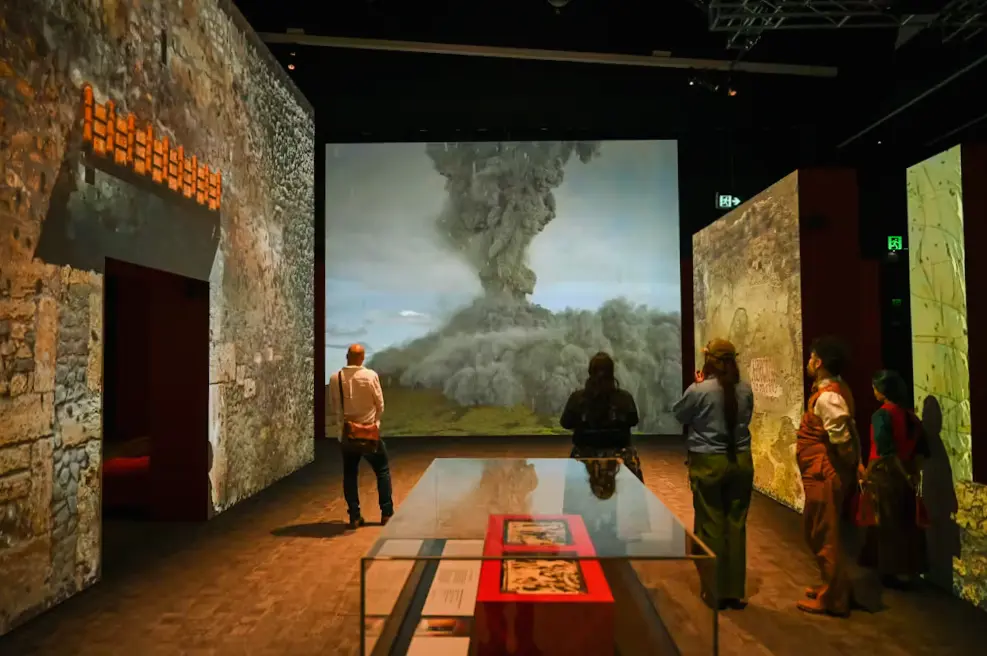
The Pompeii exhibition Canberra turned the National Museum of Australia into a time machine. For a few months, visitors could step out of modern Canberra and straight into the streets of an ancient Roman city frozen at the moment disaster struck.
Through enormous digital projections, soundscapes and more than 90 original objects from Pompeii, the exhibition invited people to walk a Roman street, stand beneath a looming digital Mount Vesuvius and see the everyday belongings of a community wiped out almost 2,000 years ago. It was part blockbuster show, part history lesson and part emotional encounter with a city that still feels strangely alive.
In this long-form guide, we’ll explore every angle of pompeii exhibition canberra – from its immersive technology and carefully chosen artefacts, to its human stories, visitor reactions and long-term impact on how Australians see ancient history.
What Was the Pompeii Exhibition Canberra?
The Pompeii exhibition Canberra was a major international exhibition hosted at the National Museum of Australia in Acton. It ran from December 2024 through to early May 2025 and was billed as a multi-sensory, immersive experience rather than a traditional display of glass cases and text panels.
At its core, the exhibition combined:
- A 360-degree digital recreation of the eruption of Mount Vesuvius
- A long, projected street from the city of Pompeii, shown “then and now”
- A selection of more than 90 artefacts from the archaeological park of Pompeii
- Powerful stories about the people who lived and died there
The museum described the exhibition as a “multi-sensory immersive experience” that recreated life in Pompeii on the eve of the eruption and followed the city through destruction, rediscovery and ongoing archaeological work. Rather than focusing only on ruins and tragedy, pompeii exhibition canberra set out to show the city as a place of daily routines, social life and human relationships.
Pompeii Exhibition Canberra – A Global Collaboration
One reason the Pompeii exhibition Canberra felt so ambitious is that it was built on a major international partnership. The show was an exclusive collaboration between:
- The National Museum of Australia in Canberra
- Parco Archeologico di Pompei in Italy (the managing authority for the site)
- Réunion des Musées Nationaux – Grand Palais in France
- GEDEON Experiences, a French media and production company specialising in immersive shows
The immersive component, sometimes called Pompeii Immersive, was originally developed in Europe and adapted for its Australian premiere. GEDEON’s team used high-resolution projections, 3D reconstructions and custom sound to create a virtual Pompeian street and a digital Mount Vesuvius that erupted on a loop.
National Museum director Katherine McMahon called the show “a portal through time, unveiling the secrets of an ancient world”, saying it allowed people to experience Pompeii both as a Roman city and as an ongoing site of discovery “like never before”. That sense of stepping directly into another time was exactly what the collaboration was designed to achieve.
Pompeii Exhibition Canberra – Immersive Streets & Erupting Volcano
If you ask visitors what they remember most vividly about the pompeii exhibition canberra, two features come up again and again: the recreated street and the erupting volcano.
Walking a Roman street in Canberra
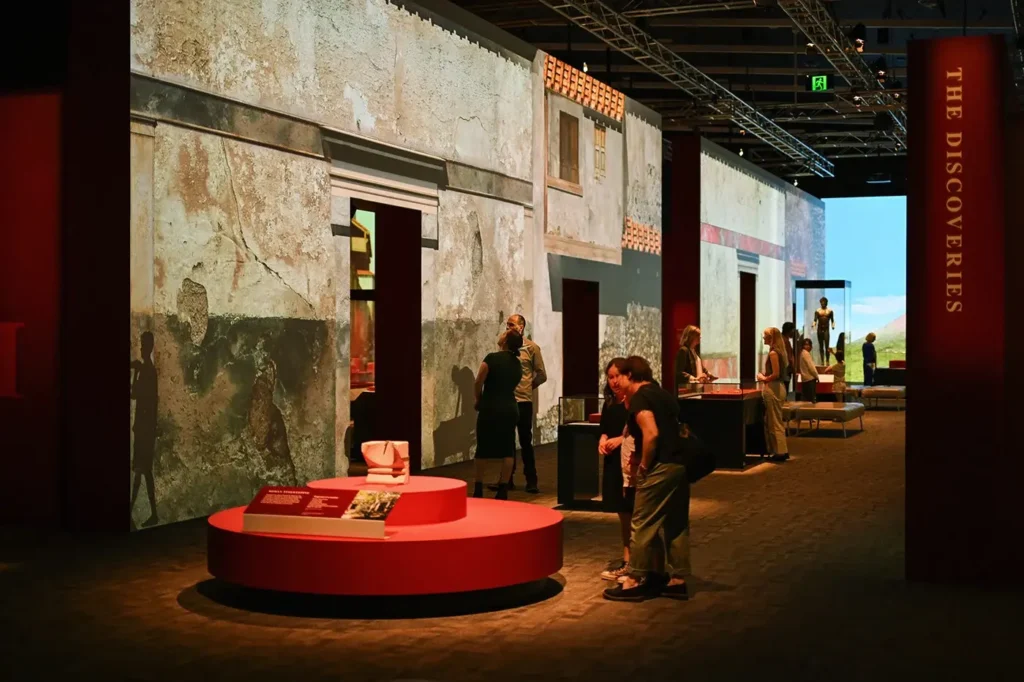
One of the galleries was transformed into a 35-metre Pompeian street. Along its length, visitors saw projected building façades, doorways, balconies and windows taken directly from real locations in Pompeii. Shadowy figures appeared and disappeared: shoppers, workers, children, people visiting shrines or stopping to talk.
The street had a “then and now” feel. On one side, visitors saw reconstructions of houses and shopfronts as they might have looked in 79 CE: painted walls, signage, open doorways and bustling movement. On the other, they saw modern footage of the same buildings as they stand today in the archaeological park – weathered stone, missing roofs and exposed interiors.
Created by Gedeon Programmes, the streetscape surrounded visitors with light, sound and subtle movement so they felt as though they were standing inside the city itself. Everyday sounds – footsteps on stone, quiet chatter, the rumble of carts – gave the impression that life was continuing beyond the edges of the screen.
A 360-degree eruption of Mount Vesuvius
The emotional heart of the pompeii exhibition canberra was its digital volcano. In a circular space with tall projection walls, visitors stood inside a 360-degree recreation of Mount Vesuvius and the surrounding landscape. Every 15 minutes, day turned to night as the volcano erupted in light, colour and sound.
The sequence showed ash plumes rising, fiery fragments raining down and thick clouds engulfing the city. Audio effects layered thunder, crackling, distant shouts and the low roar of pyroclastic flows. As the eruption progressed, the sky darkened and the city disappeared under a storm of ash.
One critic described this feature of the exhibition as a “volcanic explosion every 15 minutes” that turned scientific reconstructions into something visitors could feel in their bodies. For many, it was the moment when Pompeii stopped being an abstract story and became a real place facing a terrifying natural disaster.
Pompeii Exhibition Canberra – Artefacts from Everyday Life
While the technology was spectacular, the pompeii exhibition canberra never forgot that physical objects are at the core of archaeology. The show brought together more than 90 artefacts loaned from the archaeological park in Italy, many rarely seen outside Europe.
Highlights from the collection
The artefacts in pompeii exhibition canberra were carefully chosen to represent both the splendour and the ordinariness of Pompeian life. Visitors could see:
- Large frescoes spanning several metres, taken from the walls of grand houses
- Intricate mosaics that once decorated floors and pool surrounds
- Jewellery in gold, silver and bronze, from delicate chains to chunky bracelets
- Sculptures & statues, including religious figures and decorative pieces
- Pottery, glassware & cookware used in kitchens and dining rooms
- Tools and household items from workshops, shops and back rooms
One reviewer commented that the objects ranged from “incredibly delicate marble and stone carvings” to everyday cooking pots and glass vessels, highlighting the full spectrum of life in the city rather than only elite luxury.
The display was arranged to draw attention to the details. Close-up lighting allowed visitors to see brushstrokes in paintings, tool marks in stone and tiny chips in glass. Captions explained how each object was used and, where known, where it came from within the city.
Stories of class & labour
Curators for pompeii exhibition canberra made a conscious effort to include the experiences of people from various social backgrounds. Instead of focusing solely on wealthy villa owners, the exhibition showed:
- the tools and belongings of tradespeople
- storage jars and simple plates used by ordinary households
- religious objects used in small domestic shrines
- items related to enslaved labour and service work
National Museum curator Lily Withycombe said that “at the heart of this exhibition is real, lived human experience, and that’s how people connect with the ancient past.” That meant paying attention not just to statues of gods and grand dining rooms, but also to the aprons, ladles and storage vessels that kept everyday life running.
Pompeii Exhibition Canberra – Casts, Loss & Human Stories
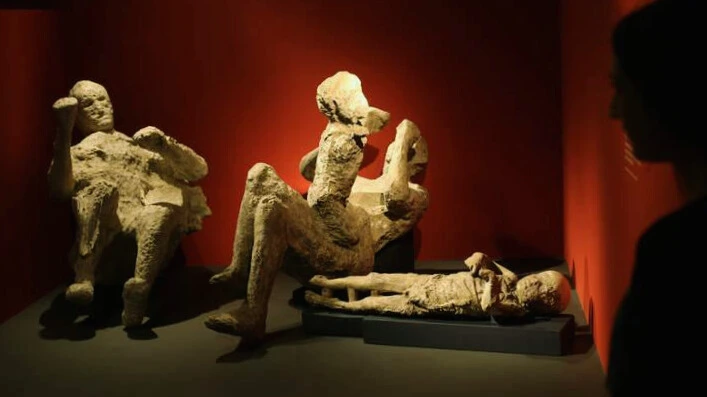
One of the most confronting elements of pompeii exhibition canberra involved the people of Pompeii themselves. Over the 19th and 20th centuries, archaeologists created plaster casts of victims by pouring liquid plaster into voids left in the ash after the bodies had decomposed. These casts capture final poses in heartbreaking detail.
The exhibition included replica casts of several individuals: adults, a child and even a dog caught in the eruption. Displayed in subdued lighting with sensitive interpretation, they reminded visitors that the disaster was not only a geological event but a human tragedy.
Researchers and curators have increasingly emphasised the need to treat these remains respectfully. Instead of presenting them as morbid curiosities, pompeii exhibition canberra used them as starting points for stories about families, workers and neighbours whose lives were cut short.
One reflection from the curatorial team captured this approach: “While the eruption destroyed the city, it also preserved it.” That preservation allows modern viewers to see what people owned, how they decorated their homes and where they tried to escape – but it also demands empathy and ethical care.
Pompeii Exhibition Canberra – Before, During & After the Eruption
A key strength of the pompeii exhibition canberra was its narrative structure. Rather than treating Pompeii as a single frozen moment, the show unfolded in three stages: life before the eruption, the disaster itself and the long history of excavation and interpretation.
Life in a busy Roman town
The first part of the exhibition introduced Pompeii as a living city. Visitors learned that it was a busy port and regional centre with:
- around 10,000–20,000 residents
- bustling markets and street food stalls
- bathhouses, temples and public buildings
- townhouses, shops and workshops
Digital reconstructions showed painted walls in dining rooms, tiled courtyards filled with plants and rooftop terraces open to the sky. Artefacts from kitchens, shrines and shops illustrated what people ate, what they believed and how they earned a living.
This focus on daily life helped pompeii exhibition canberra avoid a pure disaster narrative. It reminded visitors that, before it became a symbol of destruction, Pompeii was simply home to thousands of people going about ordinary routines.
The day the sky fell – Mount Vesuvius erupts
The second stage of the exhibition brought visitors to the day of the eruption in 79 CE. While the exact timeline is still debated, most reconstructions suggest a multi-stage event in which:
- ash and pumice rained down over many hours
- roofs collapsed under the weight of debris
- toxic gas and pyroclastic flows swept through the city
In the 360-degree eruption space, the pompeii exhibition canberra used scientific models, historical accounts and creative sound design to show how quickly conditions turned deadly. Audio narration and projected maps helped explain why some residents escaped while others were trapped.
For modern audiences used to seeing the ruins in bright Italian sunlight, this dark, chaotic environment was confronting. The digital eruption made clear that Pompeii was not simply buried; it was first shaken, suffocated and burned.
Rediscovery & archaeology
The final part of pompeii exhibition canberra looked at what happened after the city disappeared beneath ash. Centuries later, Pompeii was rediscovered and became one of the world’s most famous archaeological sites.
Panels and videos explained how early excavations in the 18th and 19th centuries were often driven by treasure hunting and royal collections. Over time, techniques became more rigorous, shifting towards documentation, conservation and scientific analysis.
Recent footage from active digs showed archaeologists using drones, 3D scanning and digital mapping. Newly excavated objects, such as a bronze jug from the House of Leda and the Swan, demonstrated that Pompeii still has many stories to tell.
Curator Lily Withycombe observed that “the story of Pompeii is so important because archaeology was born here.” By placing the exhibition within that broader history, pompeii exhibition canberra emphasised that understanding the past is an evolving process, not a finished picture.
Pompeii Exhibition Canberra – Visitor Reactions & Reviews
The pompeii exhibition canberra quickly established itself as one of the National Museum’s major draws. Described as a summer blockbuster, it attracted visitors from Canberra, interstate and overseas.
Critical response
Arts writers and reviewers generally praised the exhibition. Common themes in reviews included:
- Admiration for the scale and ambition of the immersive elements
- Appreciation of the focus on everyday life and lesser-known stories
- Emotional impact of the human remains and personal objects
Several commentators highlighted the balance between spectacle and substance. One noted that the eruption and streetscape sequences enhanced rather than overshadowed the artefacts, helping visitors imagine the objects in their original settings rather than seeing them as isolated museum pieces.
Another reviewer pointed out that pompeii exhibition canberra encouraged visitors to think about modern risks and disasters, drawing a subtle parallel between ancient volcanic danger and contemporary concerns about climate, environment and urban vulnerability.
Public impressions
Visitor comments shared online and in word-of-mouth conversations suggest a mix of excitement and reflection. Many people:
- described the eruption sequence as intense but unforgettable
- praised the variety and beauty of the artefacts
- commented on the emotional impact of seeing casts of victims
Some visitors noted that there was a lot to take in and that slower pacing rewarded repeat visits. Others commented on the ticket price, pointing out that blockbuster exhibitions with high-end technology are costly to produce but also hard to experience anywhere else.
Pompeii Exhibition Canberra – Why It Mattered for Canberra
Beyond its immediate wow factor, the pompeii exhibition canberra had broader significance for the ACT and for Australian museums more generally.
A Southern Hemisphere first
The Canberra show was the first time this particular immersive Pompeii experience had been presented in the Southern Hemisphere. That gave the National Museum a genuine exclusive and positioned the city as a serious destination for big-ticket cultural events.
For locals, it meant they could see world-class content without travelling to Europe. For interstate travellers, the exhibition added another reason to plan a trip to Canberra, alongside the National Gallery, Parliament House, the Australian War Memorial and other national institutions.
A showcase for museum technology
The pompeii exhibition canberra also became part of a larger conversation about technology in museums. Australian institutions have increasingly turned to projection, VR, AR and digital storytelling to attract audiences who are used to high production values in their everyday media.
One museum expert noted that “the capacity for immersive technology to allow us to see and experience what has been lost to the ancient past should not be underestimated.” At the same time, there is an ongoing debate about cost, accessibility and the risk that screens might distract from original objects.
By most accounts, pompeii exhibition canberra managed to strike a healthy balance. The technology didn’t replace artefacts; it framed them and gave visitors emotional entry points into their stories.
Education & school programs
The National Museum supported the exhibition with school programs, audio material and teacher resources. Students could explore themes such as:
- natural disasters and risk
- life in ancient Rome
- archaeology and conservation
- ethics of displaying human remains
For schools, pompeii exhibition canberra offered an engaging way to meet curriculum goals in history, geography and social studies while giving students a memorable, sensory experience they couldn’t get from a textbook alone.
Pompeii Exhibition Canberra – A City That Still Speaks
In the end, the lasting achievement of the pompeii exhibition canberra was its ability to make a distant catastrophe feel personal and immediate. Visitors didn’t just read about Mount Vesuvius; they heard it rumble around them. They didn’t just see static ruins; they walked through a living street and watched it vanish under ash.
Most importantly, they saw the jewellery, cookware, statues and tools that belonged to real people – parents, children, workers, business owners, enslaved individuals – whose lives were interrupted on an ordinary day in 79 CE.
As the museum’s director put it, the exhibition “connects us with the people and their lives in entirely new ways.” That connection lives on long after the digital volcano has gone dark and the crates have been packed for their journey home.
For anyone still searching pompeii exhibition canberra, this article stands as a record of what the exhibition achieved and why it resonated so strongly. It reminds us that even cities buried in ash can continue to speak – not only about the past, but also about how we live, what we value and how we face disaster in our own time.
FOR MORE INFORMATION VISIT US AT AUSTRALIANMAGAZINE.COM.AU


In Australian food history, some names are remembered because they appear on television or in cookbooks. Others are remembered for building something lasting, practical, and influential behind the scenes. Colin Beer belongs firmly in the second group.
Best known as the co-founder of Pheasant Farm in South Australia’s Barossa Valley, Colin Beer helped shape one of the country’s most distinctive gourmet food businesses. Working alongside his wife, Maggie Beer AO, he played a central role in turning farming, retail, tourism, and artisanal production into a model that would influence Australia’s speciality food sector for decades.
What makes his story compelling is that it is not just about business success. It is about vision: seeing value in quality produce, understanding how to connect farm and table, and building a brand around authenticity long before “farm-to-table” became a marketing cliché.
Who Is Colin Beer?
Colin Beer is an Australian businessman, farmer, and food industry pioneer. He has been active since the 1970s and is widely recognised for his contribution to the development of Premium Australian food products, particularly through the Barossa Valley enterprise he helped establish with Maggie Beer.
He is also known as the husband of celebrity chef, author, and food entrepreneur Maggie Beer. But reducing him to that role alone would miss the point. Colin Beer was not simply a supportive partner; he was a hands-on builder of a business that helped put the Barossa Valley on the gourmet map.
The Beginning of a Food Legacy
The foundation of Colin Beer’s influence was laid in the 1970s. At that time, Australian food culture was very different from what it is today. There was far less emphasis on artisanal production, regional provenance, or speciality retail. Much of the modern appetite for quality local produce had yet to emerge.
That is why the Beer family’s early work mattered so much.
A major turning point came with Colin Beer’s Churchill Fellowship in 1978. During this study trip, he examined commercial game bird farming in Europe and the United States. That experience helped inspire the business model that followed. It was not just a research trip; it was a blueprint for a new way of thinking about farming and food production.
Why the Fellowship Mattered
The fellowship helped shape several important business ideas:
- Farming could be more than commodity production; speciality food products could create stronger value than raw outputs alone;
- visitors would be interested in the story behind the food;
- quality and originality could become competitive advantages.
These ideas may sound obvious now, but at the time they were forward-thinking.
Pheasant Farm and the Barossa Valley Breakthrough
In 1979, Colin Beer and Maggie Beer opened their first farm shop through Pheasant Farm in the Barossa Valley. What began as a small-scale operation eventually became one of Australia’s best-known gourmet food brands.
The business did not rely on one revenue stream. Instead, it combined several elements:
- farming;
- tourism;
- retail;
- specialty food production.
That mix was one of its strengths. Visitors were not only buying food; they were buying an experience. They could see the environment, understand the product, and connect emotionally with the brand.
Products That Built the Reputation
Pheasant Farm became known for Premium items such as:
- pâté;
- verjuice;
- speciality foods focused on natural quality.
These products helped establish a reputation for craftsmanship and integrity. In an industry where shortcuts can be tempting, the Beer business stood out by leaning into authenticity and careful production.
Colin Beer’s Role in a Changing Food Culture
Colin Beer’s contribution goes beyond the success of a single business. He helped demonstrate a broader model for rural entrepreneurship in Australia.
His work showed that a farm could be:
- a production site,
- a destination,
- a retail brand,
- and a cultural asset.
That approach influenced how many later producers thought about building food businesses. Instead of selling only ingredients, they began selling identity, story, and trust.
A Practical Business Lesson
One of the most valuable lessons from Colin Beer’s career is that niche products can outperform generic ones when they are supported by strong branding and consistent quality. That lesson still applies today.
For example, a producer of artisanal preserves, cheeses, or condiments may not compete on volume, but can succeed through:
- clear origin stories;
- distinctive packaging;
- direct customer relationships;
- and a reputation for excellence.
Colin Beer understood this early.
The Partnership with Maggie Beer
Any account of Colin Beer would be incomplete without acknowledging the partnership that defined much of his public legacy. His relationship with Maggie Beer became one of the most recognisable collaborations in Australian food.
Their work together mattered because it fused complementary strengths: farming, product development, public-facing communication, and brand-building. Maggie Beer went on to become a household name through cookbooks, media, and advocacy. At the same time, Colin Beer remained closely associated with the practical and entrepreneurial foundations that made that success possible.
Their partnership is often remembered as a landmark in Australian food history because it represented a new kind of success story: regional, family-based, quality-driven, and deeply tied to place.
Television and Public Recognition
Colin Beer also appeared on television. He featured in 21 episodes of the ABC series The Cook and the Chef from 2006 to 2009, appearing as himself and supporting Maggie Beer on screen.
This mattered for more than visibility. It helped bring the behind-the-scenes reality of food production to a wider audience. Viewers could see that great food does not begin in a studio kitchen. It begins on farms, in workshops, and in working relationships built over years.
What Sets Colin Beer Apart?
Many people contribute to a successful business. Fewer help create a model that lasts. Colin Beer stands out because his work combined several qualities that are often missing when businesses are built too quickly.
His strengths included:
- long-term thinking rather than short-term sales;
- respect for product quality;
- willingness to innovate from research and travel;
- understanding the value of place-based branding;
- ability to integrate agriculture and hospitality into a single ecosystem.
These are not glamorous traits, but they are the traits that build durable enterprises.
Common Mistakes He Avoided
There are also useful lessons in what Colin Beer did not do.
1. He did not chase mass-market sameness
Instead of trying to be everything to everyone, the Beer business stayed focused on distinctive, Premium products.
2. He did not separate production from experience
The business was not only about making food. It was about telling the story of the food.
3. He did not ignore the value of tourism
Many producers treat tourism as an afterthought. Beer recognised it as part of the business model.
4. He did not rely on branding alone
The brand worked because the product quality supported it.
Legacy and Future Outlook
Colin Beer’s legacy remains important because the food industry now values many of the things he helped champion decades ago: traceability, provenance, local identity, artisanal quality, and customer experience.
Today’s consumers increasingly want to know:
- where food comes from;
- how it is made;
- who made it;
- and why it matters.
That is exactly the kind of thinking Colin Beer helped normalise.
His story also has future relevance for small producers and regional entrepreneurs. As markets become more crowded, businesses that can combine authenticity, quality, and a clear point of view are more likely to endure. In that sense, the Beer model still feels modern.
Final Thoughts
Colin Beer may not be as publicly famous as some food personalities, but his contribution is substantial. He helped build a business that changed the way Australians think about regional food, farming, and gourmet retail.
From the Churchill Fellowship in 1978 to the launch of Pheasant Farm in 1979 and beyond, his career reflects the power of curiosity, discipline, and long-term vision. Together with Maggie Beer, he helped transform a Barossa Valley farm into an enduring symbol of Australian food excellence.
For anyone interested in food entrepreneurship, rural innovation, or the history of Australian gourmet culture, Colin Beer is a name worth remembering.

Every leader remembers the moment the ground shifted beneath them — the day they stopped managing a single team and started leading other leaders. It’s a transition that looks straightforward on an org chart and feels anything but in real life. Few people have spent as much time studying that exact moment of change as Ian Lees, an Australian leadership coach and author whose work has quietly shaped how a generation of senior leaders think about growth, identity, and influence.
This article looks at who Ian Lees is, what he has built, and why his approach to leadership development continues to resonate with executives across the private, public, and not-for-profit sectors.
Early Career and the Making of a Coach
Long before Ian Lees became known as an author, he built his reputation the way most respected coaches do: in the room, working directly with leaders wrestling with real decisions. His coaching practice grew out of a simple observation, repeated across dozens of organisations — the skills that make someone an excellent individual contributor or team leader are rarely the same skills needed to lead other leaders.
Rather than treating leadership development as a checklist of competencies, Lees approached it as a question of identity: how leaders see themselves, how that self-image shapes their decisions, and how it either expands or limits the impact they can have. That grounding in what’s often called an “ontological” view of leadership — focused on a person’s way of being, not just their behaviours — became the foundation of everything he later built.
Key Contributions: Optimal Future and “Becoming a Leader of Leaders”
Today, Ian Lees is best known as the lead coach at Optimal Future, a specialist coaching practice built around a straightforward mission: helping leaders create the best possible future for themselves, their teams, and their organisations. Through Optimal Future, he works with senior, emerging, and high-potential leaders who are stepping into bigger, more complex roles and need to lead with clarity rather than simply survive the transition.
His most visible contribution to the field is his book, Becoming a Leader of Leaders: How to Succeed in Bigger Jobs and Still Have a Life. The book distils years of coaching conversations into a practical guide for one of the most demanding transitions in any career — moving from leading a team to leading other leaders. Rather than offering generic management theory, it walks readers through recognisable, relatable scenarios: the newly promoted manager drowning in two ringing phones, the brilliant engineer suddenly responsible for sixty people, the team lead who has the new title but hasn’t yet given herself permission, mentally, to own the bigger role.
A few of the ideas at the heart of the book include:
- Managing yourself in the moment so that decisions come from clarity rather than reactivity.
- Giving yourself the promotion in your own head before the organisation fully catches up with it.
- Creating space for the leaders who report to you so they can actually lead, rather than waiting to be told what to do.
- Integrating your team’s work with the wider organisation, so both stay relevant as circumstances change.
The book has drawn praise from senior figures in leadership development and academia, including a Deputy Vice-Chancellor at the University of Wollongong, who described it as a practical, self-reflective guide to one of the toughest transitions leaders face. Coaching and organisational development professionals at large government agencies and international banks have echoed that view, praising the book’s combination of real-world examples with deeper theory.
Public Profile: A Coach Known for Substance Over Style
Ian Lees has built his public profile the old-fashioned way — through the quality of his work rather than self-promotion. His writing on the Optimal Future leadership blog covers themes that go well beyond generic management advice: the psychological weight of leadership transitions, the fear many leaders feel presenting to senior executives, the discipline required to stay calm and effective in the moment, and the often-overlooked emotional toll of scaling a role from a handful of direct reports to dozens.
He has also lent his experience to other coaching organisations, including as the lead voice behind coaching methodologies built on ontological principles — approaches that treat personal growth and professional development as two sides of the same coin, rather than separate tracks. This reputation for depth, rather than quick fixes, has made him a trusted voice for organisations trying to prepare their next generation of senior leaders for genuinely bigger jobs, not just bigger titles.
Common Mistakes Leaders Make (In Lees’s View)
Drawing on the patterns highlighted throughout his coaching work and writing, a few recurring mistakes stand out:
- Continuing to solve problems directly instead of building the judgement of the leaders who now report to you.
- Waiting for a new title to feel earned rather than actively stepping into the identity of the bigger role.
- Underestimating the emotional difficulty of the transition, treating it as purely technical or logistical.
- Failing to integrate the team’s work with the broader organisation, which leaves both increasingly disconnected over time.
Current Activities (2026)
As of 2026, Ian Lees continues to lead coaching engagements through Optimal Future, working with leaders across complex organisations who are navigating exactly the kind of transition his book addresses. His coaching philosophy — rooted in self-awareness, sustainable performance, and genuine influence rather than control — remains just as relevant in a workplace still adjusting to hybrid work, generational change, and rising expectations of senior leaders. New coaching clients continue to receive his book as a companion to their sessions, reflecting how closely his writing and his day-to-day coaching practice are intertwined.
Looking Ahead
The demand for thoughtful, identity-based leadership coaching shows no sign of slowing down. As organisations flatten their structures and push accountability further down the chain, more professionals will find themselves thrust into “leader of leaders” roles earlier in their careers — often with less preparation than the moment deserves. Coaches like Ian Lees, who focus on the internal shift required alongside the external skills, are likely to remain in demand precisely because that gap between title and readiness isn’t closing anytime soon.
Conclusion
Ian Lees represents a particular kind of leadership expert — one who has resisted the temptation to reduce leadership development to slogans or quick frameworks. Through his coaching practice at Optimal Future and his book Becoming a Leader of Leaders, he has offered a grounded, human alternative: help people become who they need to be, and the skills tend to follow. For anyone standing at the edge of a bigger job and wondering if they’re ready, his work offers a reassuring message — readiness isn’t something you wait for. It’s something you build, deliberately, one honest conversation at a time.

Kingston Library is one of Canberra’s most welcoming local library branches. Situated in the inner-south suburb of Kingston, it forms part of the Libraries ACT network. It serves residents, families, students, workers and older community members who want more than a quiet place to borrow books.
A good public library is never just a building with shelves. It is a civic space. It is where children first discover stories, where students find a desk, where older residents stay connected, where job seekers use computers, where new arrivals practice language, and where lifelong readers follow their curiosity wherever it leads.
Kingston Library carries that role with a distinctly local feel. It sits in one of Canberra’s historic neighborhoods, close to shops, cafés, apartments, offices and public transport routes. For many people in the area, it is not only a place to visit occasionally. It is part of the rhythm of daily life.
What Is Kingston Library?
Kingston Library is a public library branch operated by Libraries ACT. It is located at 54 Giles Street in Kingston, Canberra, and is part of the wider ACT public library system.
Because it is part of Libraries ACT, membership is not limited to Kingston residents. Library members can use services across the ACT branch network and access digital resources online. That networked model is one of the great strengths of modern public libraries. A local branch offers neighborhood convenience, while the wider system provides access to a much larger shared collection.
Kingston Library is especially useful for people living or working in Kingston, Barton, Griffith, Manuka, Narrabundah, Fyshwick, Russell and nearby inner-south areas.
Kingston’s Local Setting
Kingston is one of Canberra’s oldest suburbs, with a history tied to the early development of the national capital. The surrounding shopping precinct has long served as a local gathering point, and the library fits naturally into that pattern.
A library in a place like Kingston does more than provide books. It supports the suburb’s social fabric. People may visit before shopping, after school, during lunch breaks or while meeting friends nearby.
This neighborhood setting gives Kingston Library a practical advantage. It is accessible, familiar, and connected to everyday errands. The best local libraries often work this way: they are easy to incorporate into everyday life.
Facilities and Resources
Kingston Library offers the core resources people expect from a public library, including print collections, digital access and spaces for reading or studying.
Typical library resources include:
- fiction and non-fiction books;
- children’s books;
- young adult titles;
- magazines and newspapers;
- audiobooks;
- DVDs or media items where available;
- computers;
- Wi-Fi access;
- printing and scanning services;
- study and reading spaces;
- catalog access;
- self-service borrowing and returns.
The exact availability of facilities can change, especially as Libraries ACT updates systems and branch equipment, so visitors should check current details before relying on a specific service.
Still, the purpose is clear: Kingston Library offers a practical mix of reading, technology and community support.
Borrowing Books and Library Materials
Borrowing remains the heart of the library experience. Whether someone wants a crime novel, a children’s picture book, a biography, a cookbook, a gardening title or a study guide, the library provides access without the cost of buying each item individually.
Libraries ACT membership allows users to borrow items and place holds through the catalog. This is especially useful if a book is held at another branch. Rather than traveling across Canberra, readers can often request items and collect them from a convenient location.
For families, this is a major saving. Children move through reading levels quickly, and buying every book can become expensive. A library card gives them room to explore without financial pressure.
Digital Resources
Modern libraries are no longer limited to physical shelves. Libraries ACT provides digital resources that allow members to read, learn and research from home.
Digital services may include:
- eBooks;
- eAudiobooks;
- online magazines;
- research databases;
- digital learning tools;
- catalog holds;
- account management;
- library app services;
- online event information.
This is especially valuable for people who cannot visit regularly. A busy parent, shift worker, student or older resident can still access library materials digitally.
The digital side of Kingston Library is, in fact, the digital side of Libraries ACT. Your local branch may be Kingston, but your online library is much larger.
Children’s Programs and Early Literacy
One of the most important roles of Kingston Library is supporting early literacy. Public libraries help children build confidence with books long before formal schooling begins.
Children’s programs may include storytime, rhyme sessions, school holiday activities, craft events, a nd family-friendly reading initiatives. These programs are not simply entertainment. They help children hear language, practice listening, recognize rhythm, build attention and associate books with warmth.
For parents and carers, children’s library sessions also provide social connection. A storytime session can become a weekly anchor, especially for new parents or families new to the area.
Community Events and Workshops
Libraries ACT branches regularly host programs and events that extend beyond reading. Depending on the calendar, these may include author talks, workshops, information sessions, community programs, cultural activities and skills-based events.
The strongest library events usually do one of three things:
- They help people learn something useful.
- They bring people together.
- They make culture more accessible.
Kingston Library’s value lies in its role within that broader public-service mission. It is a place where information and community meet.
Support for Older Residents
Libraries are especially important for older adults. They provide access to books, technology help, social activities, a nd community connection.
For older residents in and around Kingston, the library can help reduce isolation. Visiting a library gives structure to the week. Joining a book club or attending a session creates opportunities for conversation. Using library computers or digital help services can build confidence with technology.
A good local library quietly supports independence.
Study and Work Space
Kingston Library can also serve students, remote workers and people who need a calm place to concentrate. In an age of crowded homes, expensive cafés and constant noise, free public study space is valuable.
A library study session works best when visitors come prepared:
- bring headphones;
- charge devices in advance;
- check Wi-Fi access;
- arrive early during busy periods;
- respect quiet zones;
- keep phone calls outside study areas.
For students preparing for assignments or exams, even a short, focused library visit can be more productive than working at home.
Why Kingston Library Matters
The importance of Kingston Library is not measured only by loans and visitor numbers. It matters because it provides public access to knowledge, space and culture.
In practical terms, it supports:
- literacy;
- education;
- digital inclusion;
- family learning;
- social connection;
- community resilience;
- cultural participation;
- lifelong learning.
Public libraries are among the few indoor civic spaces where people are welcome without needing to buy anything. That is increasingly rare and increasingly important.
Common Mistakes Visitors Make
One common mistake is assuming libraries are only for borrowing novels. Kingston Library offers much more, including digital access, programs and community services.
Another mistake is not checking opening hours before visiting. Libraries ACT announced changes to branch hours in 2026, so current hours should be confirmed online.
A third mistake is overlooking online resources. Many people use only the physical branch and miss out on Books, audiobooks and databases.
A fourth mistake is waiting until children are older to visit. Babies and toddlers benefit from early exposure to books and language.
A fifth mistake is thinking librarians only stamp books. Modern library staff helps with searching, technology, programs, community information, and reader guidance.
Expert Tips for Getting the Most From Kingston Library
Join the library even if you only visit occasionally. A membership gives access to both branch and online services.
Use the catalog before visiting. If a book is not at Kingston, place a hold and collect it when ready.
Follow Libraries ACT updates for event listings, school holiday programs, a nd service changes.
Ask staff for recommendations. Librarians often know new releases, hidden gems and useful resources better than any algorithm.
Make the library part of a weekly routine. Regular visits build reading habits, especially for children.
Current Offerings in 2026
In 2026, Kingston Library continues to operate as part of the Libraries ACT network, with public access to collections, services, digital tools and programs. Libraries ACT has also been updating services, including catalog improvements, self-service equipment and accessibility initiatives across the network.
For visitors, the key advice is to check the official Libraries ACT website before attending. Opening hours, programs and service availability can change across seasons, holidays and system updates.
Kingston Library remains a valued neighborhood branch, but the most accurate details will always be the current official listing.
Future Outlook
The future of Kingston Library will likely reflect the future of libraries everywhere: more digital access, more inclusive programming, more flexible community use and continued support for literacy.
Public libraries are adapting, but their core purpose remains strong. People still need trusted information, quiet space, free access and human help.
In a world full of paid platforms and noisy feeds, the library’s promise is simple and powerful: knowledge belongs to everyone.
Conclusion
Kingston Library is a vital part of Canberra’s inner-south community. Located at 54 Giles Street and operated by Libraries ACT, it offers books, digital resources, study space, children’s programs, and community services within a welcoming neighborhood setting.
Its value goes far beyond borrowing. It supports learning, family life, inclusion, digital access and connection across generations.
For residents, students, parents, workers and lifelong readers, Kingston Library remains one of those quiet public places that makes a suburb stronger.
In 2026, as library services continue to evolve, Kingston Library’s role remains beautifully simple: helping people read, learn, meet, think, a nd belong.
Colin Beer: The Quiet Architect Behind a Gourmet Food Legacy

Melissa Agnew: Mastering the Art of Authentic Voice in Australian Media

Leigh Pickford: A Story of Strength and Resilience in the Public Eye

Veronica Neave: A Multifaceted Force in Australian Arts

JK Kazzi: The Charismatic Voice of a New Generation of Cultural Influencers

The Enigma of Sirius Black: Exploring the Canonical Truth and the Quest for a Wife

Ian White Management: Guiding Athletes to Success

Comedy Lounge Perth: Where Laughter Comes to Life

Katherine Pearson: Strength, Resilience and Life Beyond the Headlines

Harrison Gilbertson in Fallen: Bringing a Fallen Angel to Life
-
 Celebrity11 months ago
Richard Zachariah – The Story of a Gentleman Journalist
-
 Lifestyle5 months ago
Top Fashion Trends Australia 2026: What Australians Are Wearing Now
-
 Lifestyle5 months ago
Spring 2026 Fashion Trends: The Complete Style Guide
-
 Lifestyle12 months ago
Matt Moran Liberal-From Service to Leadership in Western Australia
-
 News11 months ago
Samuel William Davidson – The Oatlands Tragedy, Sentence & the Power of Forgiveness
-
 News10 months ago
Beau Lamarre-Condon – Inside the Case, the Charges, and the Court Timeline
-
 Entertainment12 months ago
The Unstoppable Rhea Ripley-WWE’s Australian Phenomenon
-
 Entertainment5 months ago
How Australian Players Are Choosing Their Online Casino in 2026